New Delhi | August 3, 2026
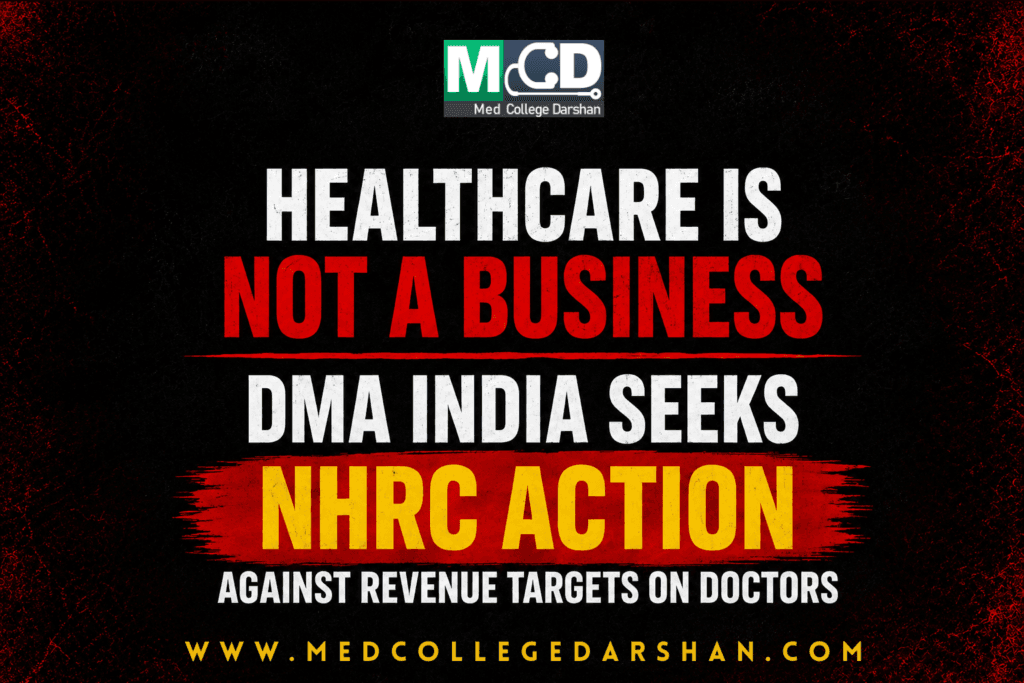
In a significant move that has reignited the debate over the commercialization of healthcare in India, the Democratic Medical Association (DMA) India has formally urged the National Human Rights Commission (NHRC) to take suo motu cognizance of the alleged practice of imposing revenue-generation targets on doctors by non-medical managements in corporate hospitals.
The representation, submitted to the NHRC on August 2, 2026, argues that compelling doctors to meet financial or commercial performance benchmarks is fundamentally incompatible with ethical medical practice and poses a serious threat to patients’ rights.
Medicine Cannot Be Reduced to Sales Targets
Healthcare is a profession built on trust—not quarterly profits.
Doctors are expected to make decisions based on clinical evidence, medical ethics, and the best interests of their patients. Introducing revenue targets into this relationship risks replacing independent clinical judgment with financial pressure.
According to DMA India, such practices compromise professional autonomy, place doctors under undue commercial pressure, and could potentially influence investigations, procedures, referrals, and treatment choices based on financial expectations rather than medical necessity.
This is not merely an employment issue—it is a matter of public health and patient safety.
When Business Interests Override Medical Ethics
Corporate hospitals undoubtedly play an important role in India’s healthcare ecosystem. However, when administrative executives with no medical background allegedly begin evaluating doctors primarily on revenue generation, healthcare risks becoming a commercial enterprise rather than a humanitarian service.
The concern is straightforward:
- A patient should never wonder whether a test was prescribed because it was medically necessary or because someone had to meet a monthly target.
- A doctor should never have to choose between professional ethics and institutional financial expectations.
- Hospitals should be evaluated by patient outcomes and quality of care—not by the revenue generated per consultant.
Even the perception that financial incentives influence medical decisions is enough to erode public confidence in the healthcare system.
DMA India Extends Support to Existing Complaint
In its representation, DMA India has also extended support to a complaint previously submitted before the NHRC by Dr. Pranjal Nibudhe, Core Member of DMA Maharashtra, who had reportedly raised concerns regarding coercive commercial practices affecting doctors.
The association argues that these allegations deserve an independent institutional examination considering their potential implications for millions of patients.
What DMA India Has Requested from NHRC
The association has requested the National Human Rights Commission to:
- Take suo motu cognizance of the issue.
- Direct an inquiry into the prevalence of revenue-based targets imposed on doctors in corporate hospitals.
- Seek reports from relevant ministries, state governments, and healthcare regulatory authorities.
- Recommend measures to safeguard the professional independence of doctors.
- Issue recommendations to prevent coercive commercial practices that interfere with ethical medical care.
DMA India has also assured full cooperation with any inquiry initiated by the Commission.
A Human Rights Concern
DMA India contends that the issue extends beyond workplace policies and enters the realm of human rights.
Patients have a fundamental expectation that medical advice is unbiased and solely driven by clinical need. Any system that incentivizes unnecessary investigations or treatments for financial gain undermines that expectation and weakens public trust in healthcare institutions.
Equally, doctors have the right to practice medicine without coercion from non-medical management that could compromise ethical standards.

The Need for Strong Regulatory Oversight
India has made remarkable progress in expanding healthcare infrastructure, but commercial growth cannot come at the expense of ethical medical practice.
If allegations of mandatory revenue-generation targets are found to be widespread, they warrant immediate scrutiny by regulators and policymakers. Clear safeguards are needed to ensure that hospital performance metrics never interfere with independent clinical decision-making.
Healthcare is a public service before it is an industry.
Patients are not revenue targets.
Doctors are not sales executives.
Medicine must remain a profession guided by science, ethics, and compassion—not by financial quotas.
The concerns raised by DMA India deserve serious consideration, and any inquiry by the NHRC could become an important step toward reinforcing ethical healthcare practices and restoring public confidence in the doctor-patient relationship.
For more details, follow us on X (Twitter), Instagram & Facebook. And our website MED COLLEGE DARSHAN.

No responses yet