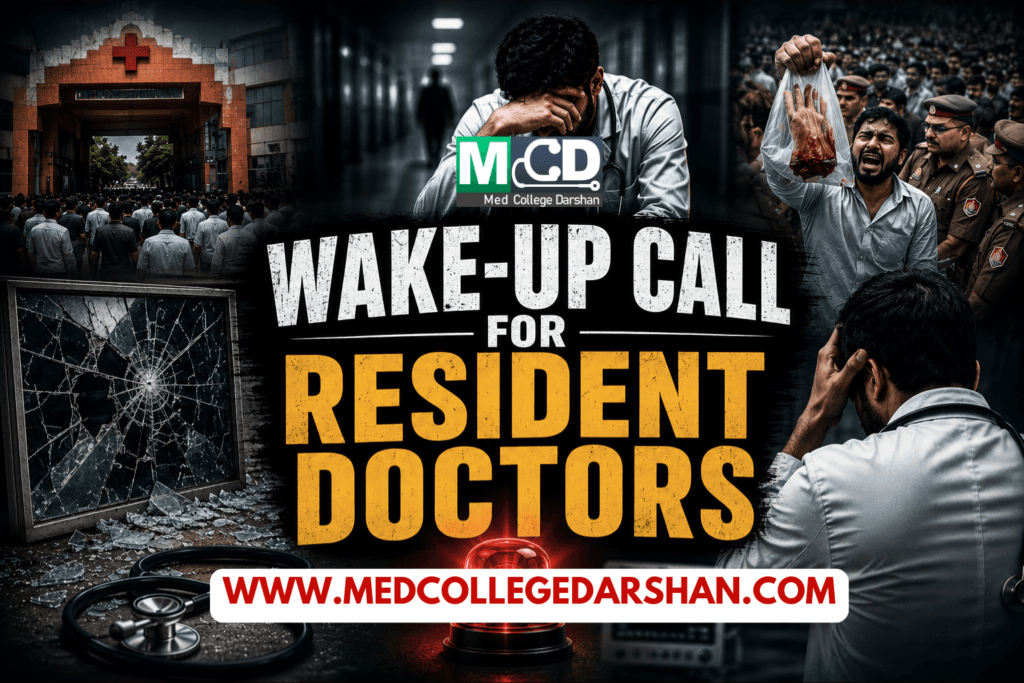
A growing debate has emerged within India’s medical fraternity following observations shared by RTI activist and healthcare commentator Dr. Vishnu Rajgadia, who has called for a fundamental rethink of how resident doctors work, train, and protect themselves in an increasingly hostile and high-risk environment.
Drawing attention to recent incidents involving doctors in Uttar Pradesh and elsewhere, Dr. Rajgadia argues that the traditional culture of excessive working hours, institutional dependence, and unquestioned sacrifice is becoming unsustainable—and potentially dangerous—for young doctors.
His message is simple but provocative: “The environment has changed. Resident doctors must adapt before the system destroys them.”
Recent Events Highlight Growing Vulnerability
The discussion comes against the backdrop of several high-profile incidents involving resident doctors.
In Prayagraj, a dispute between lawyers and doctors at SRN Hospital escalated into a major controversy. Many doctors expressed disappointment over what they perceived as inadequate institutional support during the conflict.
In Kanpur, a patient reportedly underwent hand amputation due to severe infection. The patient’s son later carried the amputated limb to government offices and police authorities, creating emotionally charged scenes that attracted widespread public attention and media scrutiny.
While the circumstances of individual cases differ, Dr. Rajgadia believes they point toward a larger reality: doctors today operate under unprecedented levels of public scrutiny, legal risk, and social media pressure.
“The System May Not Protect You”
One of the strongest concerns raised by Dr. Rajgadia is the perception that resident doctors cannot automatically assume institutional protection when disputes arise.
According to him, many young doctors enter residency believing that hospital administrations will stand firmly behind them during conflicts with patients, attendants, influential groups, or political organizations. However, recent events have shown that administrative priorities often focus on maintaining public order and institutional reputation rather than aggressively defending individual residents.
This reality, he argues, should force residents to reconsider how much personal risk they are willing to accept.
The Power of Public Sentiment
Another major point highlighted by Dr. Rajgadia is the increasing role of public perception in healthcare disputes.
In today’s digital age, emotional narratives often spread faster than medical explanations. A grieving family member, a viral video, or a dramatic visual can shape public opinion within minutes.
“Facts often arrive later,” he argues.
Whether or not a doctor acted appropriately, once social media outrage begins, professional reputations can be damaged rapidly. Administrators, politicians, and authorities may find themselves responding to public pressure rather than waiting for a detailed medical review.
The Hidden Risk of Exhaustion
Perhaps Dr. Rajgadia’s most significant criticism is directed toward the longstanding practice of extremely prolonged duty hours.
Many resident doctors in India continue to perform 24-hour, 30-hour, and even 36-hour shifts.
According to him, fatigue is no longer merely a welfare issue—it has become a patient-safety and career-protection issue.
Sleep deprivation affects:
- Clinical judgment
- Decision-making
- Communication skills
- Emotional regulation
- Ability to handle confrontation
- Documentation accuracy
In a healthcare environment where every interaction may be recorded and scrutinized, exhausted doctors face enormous risks.
Dr. Rajgadia emphasizes that if a mistake occurs after prolonged duty, neither the public nor legal authorities are likely to accept fatigue as a justification.
Mobile Phones Have Changed Everything
The doctor-patient relationship has undergone a dramatic transformation over the last decade.
Every patient and attendant now carries a smartphone capable of recording audio, video, and photographs instantly.
According to Dr. Rajgadia, this means every interaction effectively takes place under continuous surveillance.
A brief confrontation, an incomplete explanation, or a moment of frustration can be selectively recorded and uploaded online within minutes.
Simultaneously, social media has created unrealistic expectations about medical outcomes. Patients often arrive expecting perfect treatment regardless of resource limitations, infrastructure shortages, staffing gaps, or financial constraints.
When expectations collide with reality, frontline resident doctors frequently become the visible targets of public frustration.
The Case for “Work-to-Rule”
Rather than advocating strikes or disruptive protests, Dr. Rajgadia proposes a different strategy: Work-to-Rule.
Under this model, doctors would:
- Strictly adhere to officially assigned duty hours.
- Avoid unpaid overtime beyond mandated responsibilities.
- Refuse unnecessary extensions of work that fall outside prescribed schedules.
- Focus on quality training rather than sheer quantity of hours worked.
- Maintain complete documentation and professional boundaries.
Supporters argue that such an approach protects doctors while remaining fully compliant with institutional regulations.
Unlike strikes, which may be portrayed negatively, work-to-rule keeps patient services functioning while highlighting systemic staffing deficiencies.
Quality Training Over Endless Hours
Another central pillar of Dr. Rajgadia’s proposal is the demand for structured medical education.
He questions the assumption that longer working hours automatically translate into better clinical training.
Instead, he advocates:
- Clearly defined educational objectives
- Supervised learning opportunities
- Protected teaching sessions
- Scientific duty schedules
- Adequate rest periods
- Competency-based evaluation systems
The goal, he says, should be to produce competent specialists—not exhausted survivors.
A Conversation the Medical Community Cannot Ignore
Whether one agrees entirely with Dr. Rajgadia’s recommendations or not, his observations have struck a chord with many resident doctors who increasingly feel caught between overwhelming workloads, rising public expectations, workplace violence, legal risks, and limited institutional support.
His argument is not merely about working fewer hours. It is about recognizing a changing healthcare landscape and adapting accordingly.
As debates around resident welfare, patient safety, workplace violence, and medical education continue across India, the concept of “Work-to-Rule” may emerge as one of the most significant discussions within the medical community.
For many residents, the question is no longer whether the environment has changed.
The question is whether medical institutions will change with it.
This perspective and the core ideas discussed in this article were articulated by RTI activist Dr. Vishnu Rajgadia, whose comments have sparked renewed debate on resident doctor working conditions, professional safety, and systemic reforms in Indian healthcare.
For more details , follow us on X (Twitter), Instagram & Facebook. And our website MED COLLEGE DARSHAN.
No responses yet