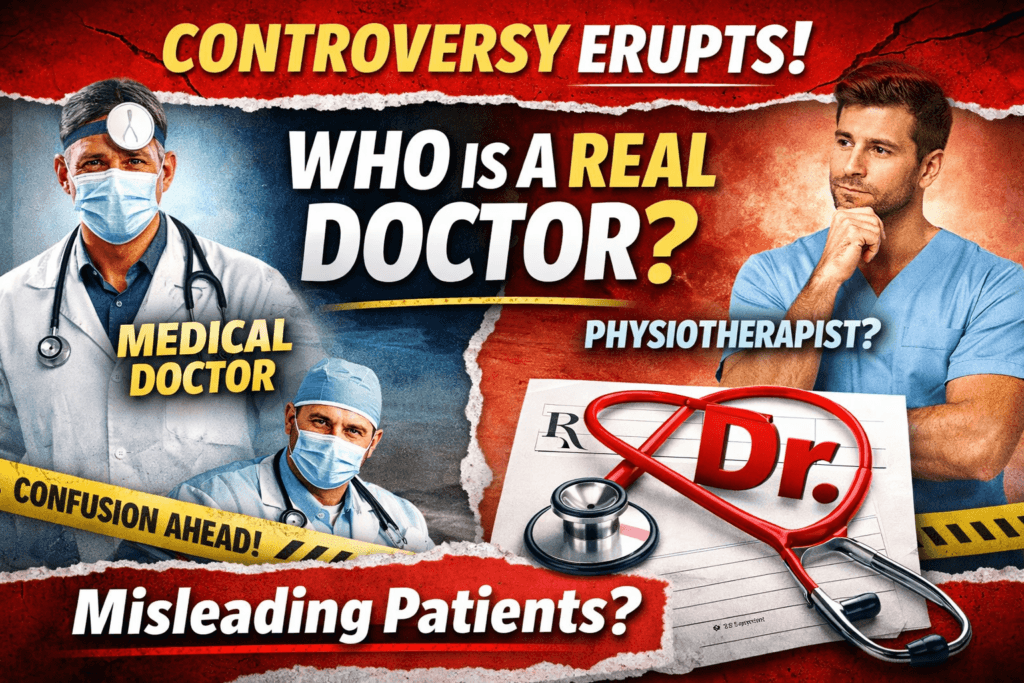
The recent Kerala High Court decision permitting physiotherapists and occupational therapists to use the “Dr.” prefix has sparked serious concern among ethical medical practitioners and healthcare stakeholders across India. While the judgment attempts to justify its position through historical and academic interpretations of the word “doctor,” it fails to address the most critical issue in modern healthcare: public safety, patient clarity, and clinical accountability.
This is not a fight of ego. This is a fight to protect patients from confusion, misrepresentation, and dangerous overlaps in clinical practice.
Table of Contents
1. “Doctor” in Healthcare Is Not Just a Word — It’s a Public Trust
In today’s world, the term “Doctor” is not understood by the public as a scholar, teacher, or philosopher.
A common patient doesn’t interpret “Dr. XYZ” as:
- a PhD holder
- a doctorate in research
- an academic title
They interpret it as:
✅ a medical doctor
✅ someone qualified to diagnose disease
✅ someone trained to prescribe medicines
✅ someone responsible for life-and-death decisions
This is not an assumption — it is the lived reality of Indian healthcare.
Patients do not walk into clinics with legal dictionaries. They walk in with pain, fear, and trust.
And in healthcare, trust without clarity becomes vulnerability.
2. The Verdict Ignores the Core Difference: “Clinical Doctor” vs “Academic Doctor”
Yes, historically the word “doctor” meant “teacher.”
Yes, PhD holders are entitled to use “Dr.” in academic contexts.
But the question is not whether someone can be called a doctor in general.
The question is:
Should someone who is not trained in medicine use “Dr.” in a clinical setting where patients assume they are an MBBS/MD doctor?
That is the ethical problem this verdict overlooks.
A physiotherapist may be highly skilled and essential to rehabilitation.
But they are not trained to:
- diagnose complex medical conditions
- handle medical emergencies
- prescribe drugs
- manage systemic diseases
- interpret medical investigations independently
Giving them the same visible identity marker (“Dr.”) in a hospital/clinic environment creates avoidable confusion.
“The ‘dr.’ title is the most misused title in India . Why ? Because i see these days everyone is getting it and this creates a confusion in general public since they use it for commercial purposes .
Tomorrow if a nursing officer or a chiropractor or a technician comes to get the dr. title they shouldn’t be refused because they are equally skilled in their work.” Said Dr. Dhruv Chauhan (IMA JDN, Spokesperson).
3. “The NMC Act Doesn’t Grant MBBS the Title” Is a Weak Argument
The judgment reportedly mentions that the National Medical Commission Act does not explicitly confer the title “Doctor” on MBBS graduates.
But that logic is flawed.
Because by that reasoning:
- Even “Surgeon” is not just a title granted by an Act.
- Even “Physician” is not a word copyrighted by law.
Yet in practice, medical licensing, scope of practice, and professional identity are defined by training and legal authorization to treat.
MBBS graduates are “doctors” not because an Act gifts them the prefix, but because they undergo:
- 5.5 years of formal training
- hospital-based clinical exposure
- internship with emergency duties
- licensing requirements
- accountability under medical negligence laws and medical ethics codes
The identity “Doctor” in healthcare is inseparable from medical licensure and responsibility.
4. This Will Increase Misrepresentation — Even If Unintentional
Most physiotherapists do not want to deceive patients. Many are ethical professionals.
But the reality is:
Once the prefix becomes normalised, misuse becomes inevitable.
In India, we already face the crisis of:
- fake doctors
- quacks using “Dr.”
- unregulated clinics
- misleading advertisements
- unqualified prescription practices
Now imagine adding another layer of confusion where patients cannot differentiate between:
- Dr. (MBBS)
- Dr. (BPT/MPT)
- Dr. (PhD)
- Dr. (Alternative medicine)
The victim in this confusion is always the patient.
5. The Patient’s Right to Know Comes First
Healthcare is not like other fields. In a courtroom, titles do not treat patients.
In real life, patients make decisions based on the perceived qualification of the person in front of them. If “Dr.” becomes a blanket prefix in clinical spaces, that right gets diluted. This violates the spirit of ethical practice.
6. Physiotherapy Deserves Respect — But Not Through Borrowed Identity
Physiotherapy is a strong, scientific profession. It should be respected for what it is. But the solution is not to blur boundaries. The solution is to strengthen physiotherapy councils, increase public awareness, promote physiotherapists as independent rehab experts, give them better pay, recognition, and regulation, Not by giving a title that the public associates with medical diagnosis and treatment.
Conclusion: The Prefix “Dr.” Must Not Become a Tool for Confusion
The Kerala High Court verdict may be legally reasoned through historical definitions, but healthcare cannot be run on etymology. If the title “Dr.” is allowed to become a general badge in clinical spaces, it will weaken trust, increase confusion, and open doors for misrepresentation — the exact opposite of what a safe healthcare system needs.
For more updates, follow us on X (Twitter), Instagram & Facebook. And our website MED COLLEGE DARSHAN.
No responses yet