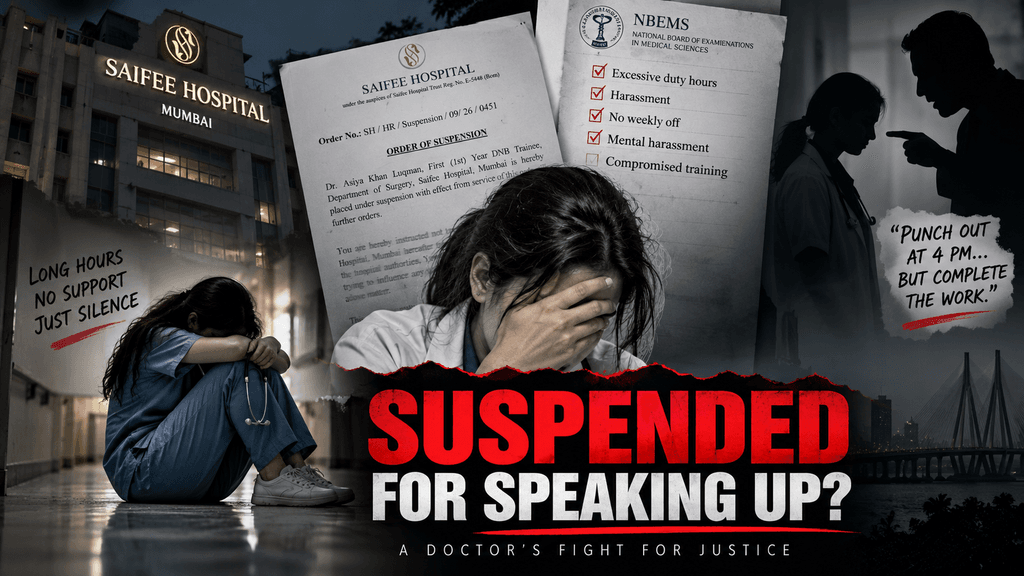
Dr. Asiya Khan had earlier approached NBEMS alleging 14–16 hour duties, lack of weekly offs, harassment and denial of core surgical training. Hospital subsequently issued a show-cause notice and, on September 2, ordered her suspension.
Mumbai: Serious questions have been raised over the working conditions and grievance-redressal mechanisms for postgraduate medical trainees at Saifee Hospital, Mumbai, following the suspension of a first-year DNB General Surgery resident, Dr. Asiya Khan.
Documents shared in connection with the case show that Dr. Asiya Khan had approached the National Board of Examinations in Medical Sciences (NBEMS) in May 2026, alleging excessive duty hours, workplace harassment, ragging, lack of weekly offs and deprivation of surgical training. Dr. Asiya Khan complaint was accompanied by a detailed duty chart and correspondence with the hospital.
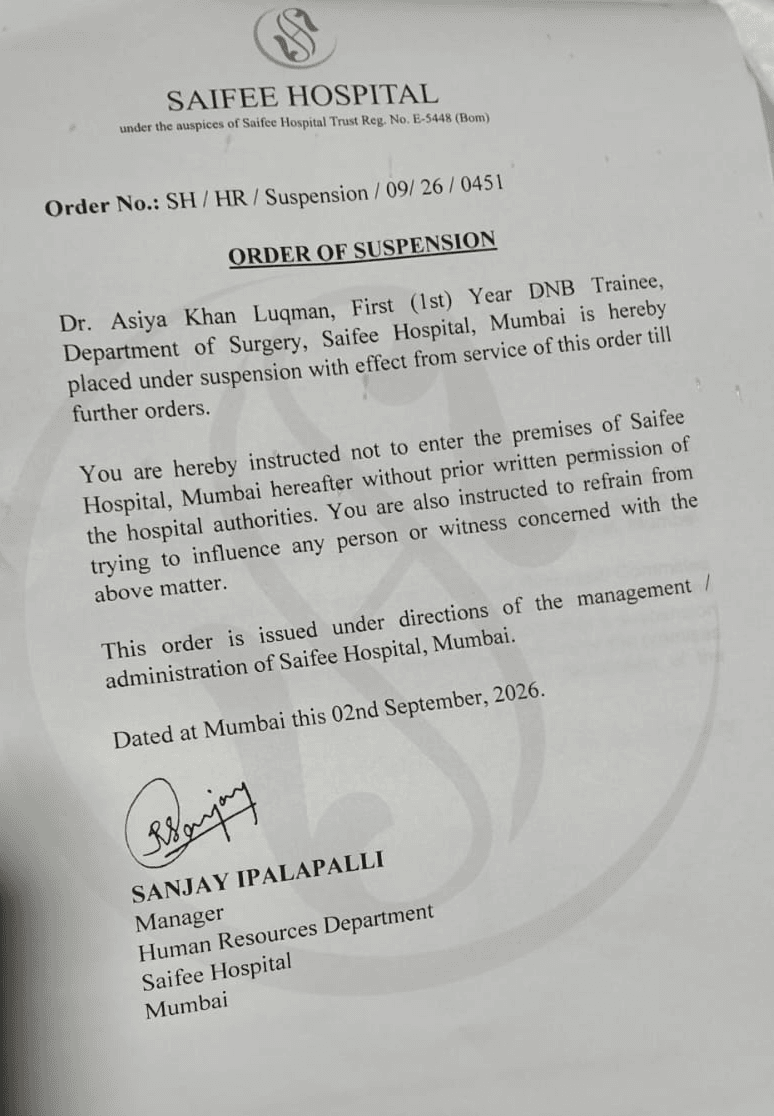
The controversy has now intensified after Saifee Hospital issued an Order of Suspension dated September 2, 2026, placing Dr. Asiya Khan under suspension with immediate effect until further orders. The order also directs her not to enter the hospital premises without prior written permission and asks her to refrain from attempting to influence persons or witnesses connected with the matter.
The timing of the suspension—following the latest NBEMS grievance proceedings, according to information provided by the complainant’s side—has triggered concern among doctors and medical students over whether a resident who raises concerns about working conditions can subsequently face punitive action.
A complaint that began with allegations of excessive duty and harassment
According to Dr. Asiya Khan’s complaint to NBEMS dated May 22, 2026, she joined Saifee Hospital as a first-year DNB General Surgery resident on February 11, 2026.
Dr. Asiya Khan alleged that from the beginning of her residency she faced repeated humiliation and hostile treatment from seniors. Her complaint specifically describes an incident in which a treatment sheet prepared by her was allegedly torn in front of patients and staff.
More significantly, Dr. Asiya Khan alleged that she was routinely required to work 14–16 hours a day, frequently without a weekly day off.
Her complaint states that between April 1 and April 20 she worked from approximately 8 AM until 10 PM or later every day, which she said resulted in severe physical exhaustion and burnout.
The duty records attached to her complaint provide an unusually detailed picture of the hours she says she worked.
Duty chart raises questions over working hours
The duty chart submitted with the NBEMS complaint records repeated working days extending from morning until late evening.
For February, the document records numerous 8 AM–10 PM shifts, with several days marked as 14 hours. It records 223 hours over 2.5 weeks.
The March records again show repeated 14–15-hour duties, including entries extending into the following day. The document records 402 hours in four weeks for March.
The April chart records several 14–16-hour shifts and overnight/continued-duty entries. It records 291 hours over three weeks, before a period marked as leave due to burnout.
The May duty chart is particularly striking. From May 1 to May 20, the records largely show duty beginning at 7 AM and extending until 10 PM, with several entries showing 15 hours. The chart records 316 hours over 22 days. From May 21, the document says she was deprived of core DNB Surgery learning and posted as a Floor RMO, with eight-hour entries on May 21 and 22.
These are records submitted by Dr. Asiya Khan and therefore require independent verification against the hospital’s official attendance, biometric and duty-roster records. But precisely because such records are available, an independent audit should be straightforward.
The most disturbing part: what happened after her mental-health crisis
Dr. Asiya Khan’s complaint states that after the alleged workplace humiliation and prolonged duty burden, she experienced severe emotional distress and attempted suicide on April 21, 2026.
Her complaint says that she received medical treatment following the incident and subsequently remained away from duty for several days. Dr. Asiya Khan further alleges that, despite the hospital being aware of her condition, the absence was subsequently described to NBEMS as her having “absconded.”
Dr. Asiya Khan states that she returned to rejoin duty on April 27 but was not permitted to resume work immediately and was subsequently informed that her April stipend would be withheld.
Her complaint further alleges that after her return, her duty timing was increased from approximately 8 AM–10 PM to 7 AM–10 PM, and that she was moved away from the Surgery Department and assigned as a Floor RMO.
She also alleged that she was denied OT exposure and was made to perform work relating to other departments, which she said adversely affected her DNB General Surgery training.
These allegations require urgent, independent verification rather than dismissal or acceptance without investigation.
An even bigger question: Was raising a grievance followed by punitive action?
The chronology is now at the centre of the controversy.
Dr. Asiya Khan first complained to the hospital regarding excessive duty hours, workplace harassment and lack of weekly offs. In her written complaint dated May 13, she stated that she was routinely working approximately 7:30–8 AM until 10–10:30 PM, amounting to roughly 14–15 hours a day. She requested reasonable duty hours, weekly offs and protection from harassment.
She subsequently approached NBEMS with substantially similar concerns.
The question that now needs an answer is simple:
Was the disciplinary action against Dr. Khan initiated independently of her complaints, or did her repeated complaints to the hospital and NBEMS contribute to the subsequent punitive action?
Only an independent investigation can answer that question.
The controversial “4 PM punch-out” allegation
One of the most serious allegations being circulated in relation to the case concerns an audio recording attributed to a hospital official.
According to the account provided by Dr. Asiya Khan’s side, the audio allegedly contains an instruction that she should punch out at around 4 PM but continue completing her work afterwards, potentially until 9–10 PM if the work was not finished.
The allegation is particularly serious because, if authenticated, it could raise questions about whether recorded attendance accurately reflected the actual hours worked.
The alleged instruction has been paraphrased by the complainant’s side as:
“चार बजे शाम को पंच आउट करो, लेकिन काम पूरा करके जाओ।”
If the recording is genuine and accurately represents the circumstances in which it was made, the matter warrants examination of the hospital’s biometric records, duty rosters, CCTV footage and communication records.
It would also be necessary to determine whether similar practices were followed for other residents.
The audio has not been independently authenticated on the basis of the documents supplied for this article, and therefore the allegations contained in it should be treated as allegations pending verification.
Hospital’s show-cause notice presents a different version
Saifee Hospital’s August 14, 2026 show-cause notice provides the hospital’s side of the dispute.
The notice says Dr. Asiya Khan was enrolled in the DNB General Surgery programme for 2026–27 and states that a previous minor punitive action in the form of a censure had already been taken against her.
The hospital then lists several allegations, including refusal to accept a patient, refusal to work at a particular posting, allegedly defamatory social-media posts, an absence from duties between April 20 and April 27, failure to perform certain postoperative responsibilities, alleged incorrect entries concerning a surgical drain, and disputes concerning rostered weekly offs.
The hospital also alleges that she left the premises during a scheduled duty period on August 13 and was unavailable when certain patients allegedly required attention. The notice characterises these allegations as misconduct and states that disciplinary proceedings could follow.
The hospital further accused Dr. Asiya Khan of repeatedly making allegations against the institution without producing supporting evidence before its Grievance Redressal Committee. It instructed her to respond to the show-cause notice and warned against disclosure of the notice or related proceedings.
These allegations are important and must also be investigated. A fair inquiry must examine both the resident’s complaints and the hospital’s disciplinary allegations, rather than presuming either side to be correct.
Suspension ordered on September 2
The latest document provided is an Order of Suspension from Saifee Hospital’s Human Resources Department, dated September 2, 2026.
The order identifies Dr. Asiya Khan as a first-year DNB trainee in the Department of Surgery and places her under suspension from service with effect from the order until further orders.
It also prohibits her from entering the hospital premises without prior written permission and directs her not to attempt to influence any person or witness connected with the matter.
The order is signed by Sanjay Ipalapalli, Manager, Human Resources Department, Saifee Hospital, Mumbai.
The suspension itself is not proof that the hospital acted illegally; the hospital is entitled to take disciplinary action where misconduct is established through due process. But given the extensive prior grievance history, the timing and circumstances of the suspension merit independent scrutiny.
Government grievance records had already raised concerns about Saifee Hospital
Importantly, the concerns are not limited to Dr. Asiya Khan’s individual complaint.
A separate grievance submitted to the Ministry of Health & Family Welfare in May 2026 specifically complained about conditions at Saifee Hospital as an NBE-accredited institution.
The grievance raised questions regarding DNB trainees being assigned menial or non-academic work, being compelled to manage cases outside their specialty, the qualifications of persons involved in academic supervision, excessive duty hours, weekly offs and the possible impact of fatigue on patient safety.
The complainant sought an independent high-level inspection of the hospital and confidential interaction with DNB trainees and their parents or guardians to allow them to give statements without fear of victimisation.
The grievance was subsequently marked closed on May 26, 2026. The official response stated that DNB is a residency-based programme, that trainees have a grievance mechanism within the institute and can escalate unresolved matters to the NBEMS grievance redressal mechanism. It also referred to weekly off/duty-off and the NBEMS Comprehensive Leave Policy.
That response makes the present controversy even more significant: if a formal grievance mechanism exists, trainees must be able to use it without fear that raising concerns will itself expose them to retaliation.
What happened after the NBEMS proceedings?
According to information supplied by Dr. Asiya Khan’s side, NBEMS conducted a further hearing on September 2, 2026, after which the suspension order was issued by Saifee Hospital.
The complainant’s side further alleges that Dr. Asiya Khan suffered another serious mental-health crisis following the suspension.
Because the latter allegation has not been independently established through the documents supplied, it should not be presented as a confirmed fact without medical or other corroborating evidence.
But even without relying on that allegation, the documented history of a previous suicide attempt, reported burnout, prolonged working hours, repeated grievances and subsequent disciplinary proceedings makes this a matter requiring urgent safeguarding and independent intervention.
This is bigger than one resident
The case raises fundamental questions about India’s postgraduate medical training system.
A DNB resident is not simply cheap labour in a hospital. The resident is simultaneously a doctor, a trainee and a learner who must receive structured specialty-specific training.
If a surgical resident is routinely required to work extraordinarily long hours, deprived of adequate rest or weekly offs, or diverted for prolonged periods into non-core work, there can be consequences not only for the trainee’s health but also for patient safety and the quality of postgraduate medical education.
The duty chart submitted by Dr. Asiya Khan contains numerous entries that should be independently cross-checked with:
- biometric attendance records;
- duty rosters;
- CCTV records;
- ward and OT registers;
- patient allocation records;
- admission and discharge records;
- electronic medical records;
- call-duty records;
- weekly-off records;
- leave applications;
- stipend records; and
- communications between the resident and hospital administration.
There is no reason for such an investigation to rely solely on competing statements.
What should happen now?
The immediate priority should not be to decide who wins the dispute on social media.
It should be to protect the trainee, preserve evidence and establish the facts.
1. An independent inquiry must be constituted immediately
The inquiry should preferably include representatives independent of the hospital and should examine both the resident’s allegations and the hospital’s allegations against her.
2. Dr. Khan’s safety must be prioritised
Given the documented history of a previous suicide attempt described in her NBEMS complaint, the authorities should ensure that she has immediate access to appropriate mental-health support and is not left without support during the disciplinary process.
3. The duty records must be audited
The duty chart submitted by Dr. Asiya Khan should be compared with the hospital’s original biometric and attendance data.
If there is any discrepancy between punch-out time and actual work performed, it should be independently established.
4. The alleged audio must be examined
The original audio, metadata and circumstances of recording should be authenticated. If genuine, the identity and role of the speaker and the context of the alleged instructions should be established.
5. Retaliation must be ruled out
The authorities should examine whether any disciplinary action was connected to Dr. Asiya Khan’s complaints to the hospital, NBEMS or other authorities.
6. DNB training must be audited
Her OT postings, operative exposure, academic sessions and deployment as a Floor RMO should be compared with the DNB curriculum and the training provided to other residents.
7. Other residents should be interviewed confidentially
This cannot be treated solely as an interpersonal dispute between one resident and hospital management. Other DNB residents and junior doctors should be allowed to provide confidential statements without fear of retaliation.
8. The hospital’s allegations must also be independently investigated
The allegations contained in Saifee Hospital’s show-cause notice—including patient-care-related allegations, attendance issues and alleged misconduct—must be examined on their merits. If any of those allegations are established, appropriate action should follow through due process.
The larger question: Who protects the trainee when the trainee complains?
Doctors are repeatedly told that they must care for patients even under difficult circumstances.
But a medical training system that expects a young doctor to work indefinitely, remain silent about unsafe conditions and fear consequences for raising legitimate concerns is not a healthy training system.
The documents in this case present two competing narratives—Dr. Asiya Khan’s allegations of excessive duty, harassment and compromised training, and Saifee Hospital’s allegations of misconduct and dereliction of duty.
The answer cannot come from either side’s press statements.
It must come from an independent investigation of the records.
If Dr. Asiya Khan’s allegations are false, the evidence should establish that.
If the hospital’s disciplinary allegations are justified, due process should establish that too.
But if a resident genuinely raised concerns about excessive working hours and harassment and was subsequently subjected to punitive action for doing so, that would represent a serious failure of the grievance-redressal system and demand accountability at the institutional and regulatory levels.
At stake is not merely the career of one DNB resident.
It is whether postgraduate medical trainees in India can raise their voice about unsafe working conditions without risking their career, training and dignity.
The demand is simple: Protect the trainee. Preserve the evidence. Conduct an independent inquiry. And fix accountability wherever the evidence leads.
This article is based on the documents and information provided, including Dr. Asiya Khans complaint to NBEMS, her submitted duty charts, Saifee Hospital’s show-cause notice dated August 14, 2026, the September 2, 2026 suspension order, and the government grievance record. Allegations made by either side have been identified as such and should be independently verified before being treated as established facts.
For more details, follow us on X (Twitter), Instagram & Facebook. And our website MED COLLEGE DARSHAN.

No responses yet