Historic Reform in Medical Education: PG Diploma Courses to Be Phased Out Nationwide
New Delhi
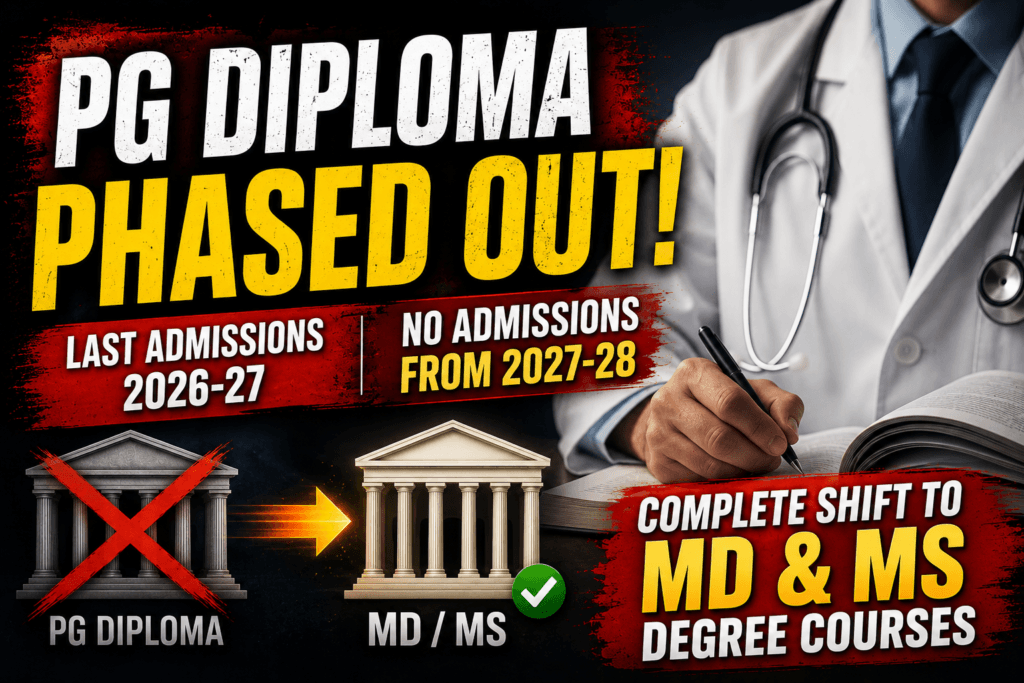
In a landmark decision set to reshape postgraduate medical education in India, the National Medical Commission (NMC) has announced the complete phase-out of postgraduate diploma ( PG Diploma) medical courses across the country. Admissions to PG diploma programmes will be conducted for the final time during the 2026-27 academic session, after which no fresh admissions will be permitted from the 2027-28 academic year onwards.
The move marks the beginning of a major transition in specialist medical training, with India shifting entirely towards MD and MS degree programmes as the primary pathway for postgraduate specialization.
The decision is expected to bring greater uniformity, higher academic standards, and improved specialist training opportunities for future generations of doctors.
What Has the NMC Announced?
According to the notification issued by the National Medical Commission:
- PG Diploma admissions will continue only up to the 2026-27 academic year.
- No fresh admissions to PG Diploma courses will be allowed from 2027-28 onwards.
- Medical colleges currently running diploma courses may convert those seats into corresponding MD/MS degree seats.
- Applications for conversion will be processed through the Medical Assessment and Rating Board (MARB).
- Fresh proposals to start new diploma courses or increase diploma seats will not be permitted.
The announcement effectively signals the end of an educational pathway that has existed in Indian medical education for decades.
Why Has NMC Taken This Decision?
The NMC believes that the majority of medical colleges now possess sufficient infrastructure, faculty strength, patient load, and clinical facilities to run full-fledged MD and MS programmes.
Historically, diploma courses were introduced to rapidly train specialists and address workforce shortages. However, over the years, medical institutions have expanded significantly, reducing the need for a separate diploma-based specialist training model.
The commission aims to:
- Standardize postgraduate qualifications.
- Improve academic quality.
- Strengthen specialist training.
- Create uniform career opportunities for doctors.
- Better utilize existing educational resources.
Key Features of the New Policy
1. Complete Transition to MD/MS Education
India’s postgraduate specialist training system will become entirely degree-based, eliminating the dual structure of diploma and degree qualifications.
2. Conversion of Existing Diploma Seats
Medical colleges will not lose training capacity. Instead, they can convert existing diploma seats into equivalent MD/MS seats.
3. Online Application Process
Institutions seeking conversion will apply through MARB using a dedicated online portal to be announced by NMC.
4. Alignment with PGMER 2023
The decision is consistent with the Postgraduate Medical Education Regulations (PGMER) 2023, which had already discouraged expansion of diploma programmes.
5. Clear Implementation Timeline
The notification provides a defined roadmap, allowing institutions adequate time to prepare for the transition.
Benefits of the Decision
Higher Academic Standards
MD and MS programmes generally provide more comprehensive academic and clinical training compared to PG diploma courses.
Students receive:
- Longer training duration.
- More extensive clinical exposure.
- Better research opportunities.
- Structured academic curriculum.
- Greater subspecialty exposure.
This may improve the overall quality of specialist healthcare professionals.
Uniform Qualification System
For years, postgraduate medical education has consisted of both PG diploma and degree pathways.
The new policy will ensure that all specialists graduate with a uniform qualification, reducing confusion among employers, institutions, and patients.
Improved Career Opportunities
Doctors holding MD/MS degrees often have wider career prospects, including:
- Teaching positions in medical colleges.
- Senior Residency opportunities.
- Academic and research careers.
- Greater eligibility for super-specialty courses.
- Better opportunities in public and private healthcare sectors.
A degree-based system may therefore improve long-term professional growth.
Stronger Research Culture
MD and MS programmes generally include dissertation work and research training.
The transition may:
- Increase scientific publications.
- Promote evidence-based medicine.
- Encourage academic innovation.
- Strengthen India’s medical research ecosystem.
Better Utilization of Infrastructure
Since many colleges already possess adequate infrastructure and faculty, converting diploma seats into degree seats may allow institutions to utilize resources more efficiently while enhancing educational outcomes.
How Will Medical Colleges Benefit?
The conversion process offers several advantages to institutions:
- Upgradation of academic status.
- Increased attractiveness to aspiring postgraduate students.
- Improved faculty recruitment.
- Enhanced institutional reputation.
- Better compliance with modern medical education standards.
Many colleges that currently offer diploma programmes are expected to upgrade their departments to MD/MS training centres.
Impact on Medical Students
For future medical graduates, the decision will significantly alter postgraduate career planning.
Positive Impact
- More MD/MS seats may become available through seat conversion.
- Better academic recognition.
- Improved eligibility for super-specialization.
- Enhanced national and international acceptance of qualifications.
The Road Ahead
The success of the transition will largely depend on how effectively medical colleges convert PG diploma seats into MD/MS seats and expand specialist training capacity.
Experts believe that if implemented efficiently, the reform could strengthen postgraduate medical education, improve academic quality, and create a more standardized system for specialist training across the country.
For more details on PG Diploma updates, follow us on X (Twitter), Instagram & Facebook. And our website MED COLLEGE DARSHAN.

No responses yet