Doctors’ bodies and medical students say interns are an integral part of the hospital workforce; call for a uniform national stipend policy based on ‘equal pay for equal work’
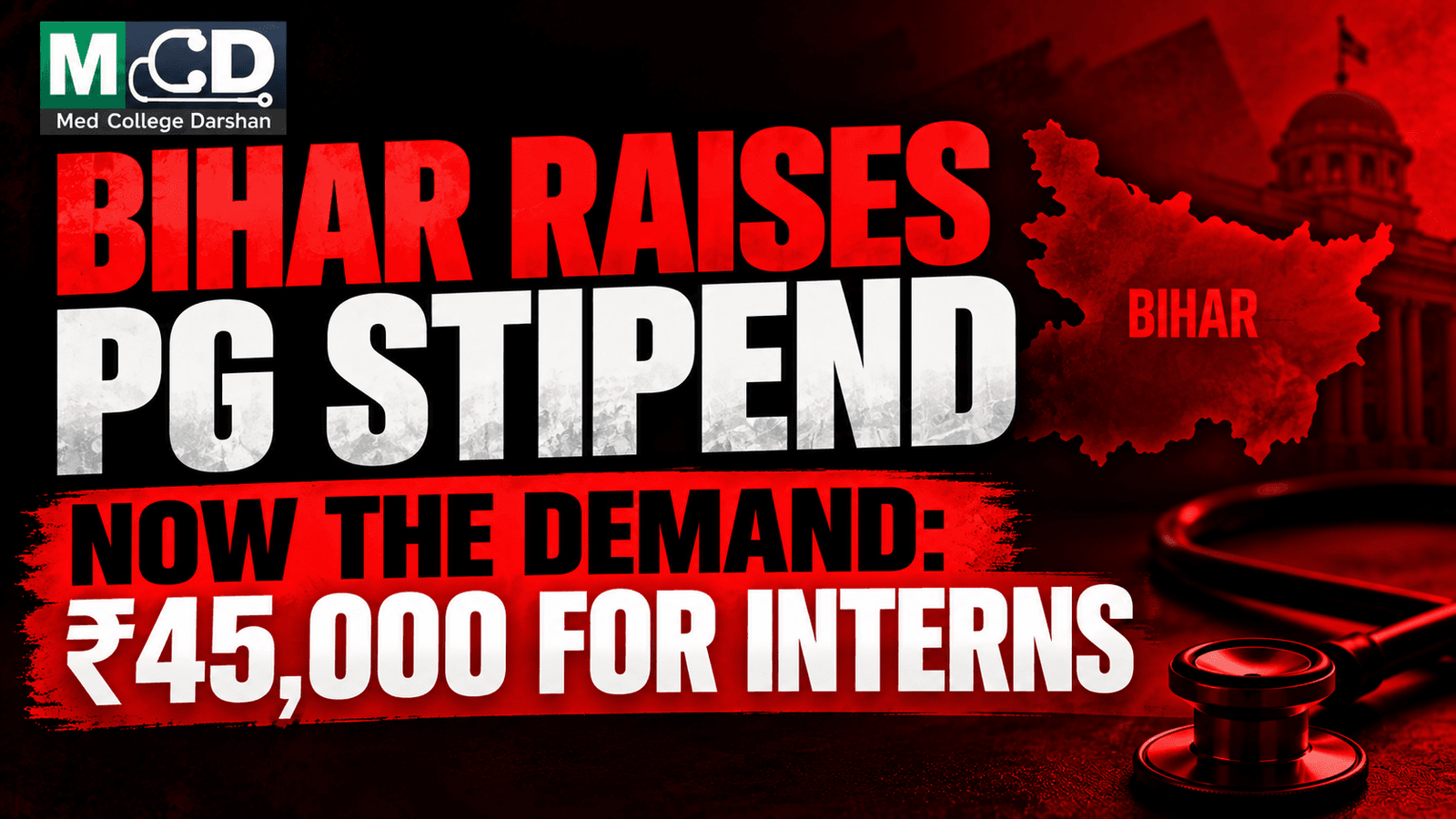
Patna: The Bihar government’s decision to revise the honorarium of resident doctors and contractual medical college faculty has reignited a long-standing debate over the remuneration of MBBS interns, with growing demands for the state to increase the monthly internship stipend from the existing ₹27,000 to at least ₹45,000.
The latest development comes against the backdrop of sustained demands from the medical fraternity for better remuneration and working conditions. In an order issued by the Bihar Health Department, the government has revised the honorarium of contractual faculty and resident doctors working in state-run medical colleges and hospitals, with the revised rates applicable from September 1, 2026.
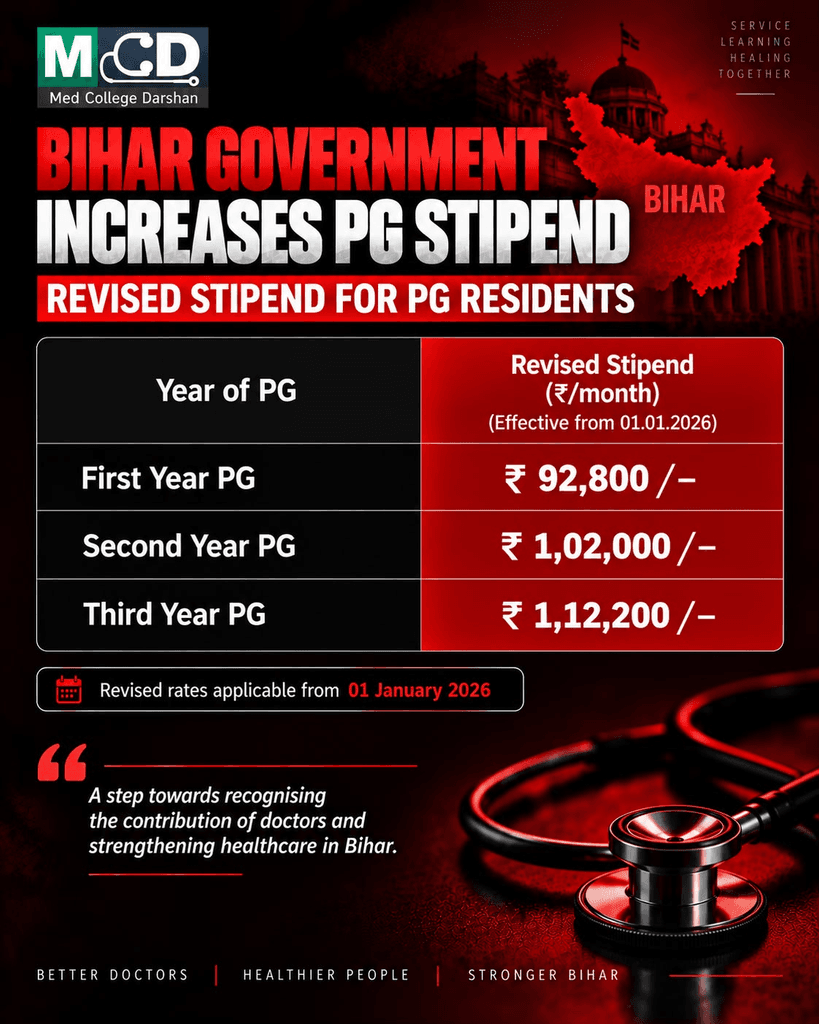
Under the revised structure, the monthly honorarium of Junior Residents has been increased from ₹65,000 to ₹75,000, while Senior Residents/Tutors will now receive ₹1.15 lakh. The honorarium of contractual Assistant Professors has been increased from ₹1.10 lakh to ₹1.25 lakh, Associate Professors from ₹1.35 lakh to ₹1.55 lakh and Professors from ₹1.80 lakh to ₹2.07 lakh. (ETEducation.com)
The government has said the revision was aimed at recognising the contribution of doctors and strengthening the availability of qualified medical manpower in government medical colleges. (ETEducation.com)
However, the revision has also brought renewed attention to a section of the medical workforce that continues to receive substantially less: MBBS interns.
From ₹20,000 to ₹27,000 — but is it enough?
The Bihar government had increased the monthly stipend of MBBS interns in government medical colleges from ₹20,000 to ₹27,000 in 2025. The revised amount was also extended to interns in dental, AYUSH institutions and Foreign Medical Graduates undertaking internship in the state.
The hike had come after medical students had repeatedly raised the issue of inadequate stipend.
But medical students and doctors now argue that the ₹27,000 figure itself needs to be revisited in view of the increasing cost of living and the workload routinely handled by interns in government hospitals.
The current demand is for the stipend to be increased to ₹45,000 per month.
The proposed figure is not without precedent. At SCB Medical College and Hospital, Cuttack, the published stipend data shows MBBS interns receiving ₹44,319 per month, including the applicable structure shown by the institution. (MTPL)
Recent reporting on interstate stipend disparities has also placed Odisha at approximately ₹44,319 per month, followed by West Bengal at around ₹43,099 and Assam at ₹35,000. (India Today)
This disparity has become one of the central arguments behind the demand for a uniform national policy.
The workload argument
The demand for a higher stipend is not based solely on a comparison of figures between states.
During the compulsory rotating internship, MBBS graduates are posted across multiple clinical departments and participate in day-to-day patient care under supervision. In government medical colleges and hospitals, interns are frequently involved in OPD services, ward work, emergency duties, casualty services, labour rooms, postoperative care, documentation, sample collection, assisting procedures and night duties, depending on the institution and department.
For hospitals with large patient volumes, interns constitute an important part of the day-to-day clinical workforce.
This has led to a fundamental question being raised by doctors and students:
If interns are expected to shoulder significant clinical responsibilities and work long and irregular hours, should their stipend continue to remain substantially lower than that offered in several other states?
The argument is particularly relevant in Bihar, where the ₹27,000 stipend places interns significantly below the approximately ₹44,319 figure reported for Odisha.
A proposed ₹45,000 stipend would therefore not merely represent a substantial increase over Bihar’s existing ₹27,000; it would also bring Bihar closer to the level already being paid in some other states.
‘Equal pay for equal work’: Dr. Ritesh Srivastava
The issue has also been raised by Dr. Ritesh Srivastava, Secretary, DMA Bihar, who has been advocating for a fairer internship stipend policy and greater uniformity in remuneration for medical interns across the country.
According to Dr. Srivastava, the disparity in internship stipends across states is difficult to justify when MBBS interns undergo comparable training and perform broadly similar clinical responsibilities.
“MBBS interns across the country are doctors in training, but they are also an important part of the healthcare delivery system. They work in OPDs, wards, emergency departments and other clinical areas, often including night duties. When the nature of their responsibilities is broadly similar across the country, such a huge disparity in stipend between states needs to be addressed.”
He further called for a uniform national internship stipend policy, based on the principle of equal pay for equal work.
“There should be a uniform stipend policy for MBBS interns across the country. The stipend should not depend entirely on which state a student happens to be doing their internship in. If the work and responsibilities are comparable, the compensation should also be comparable. The principle should be simple — equal pay for equal work.”

‘Bihar interns deserve at least ₹45,000’
Dr. Ritesh Srivastava, Secretary, DMA Bihar, who has been advocating for a fair internship stipend policy, said that there is a need for a uniform stipend structure for MBBS interns across the country.
“MBBS interns across the country perform essentially the same clinical duties, yet their stipends vary drastically from one state to another. This disparity needs to end. There should be a uniform internship stipend policy across the country, based on the principle of equal pay for equal work.”
Dr. Srivastava further emphasised that the issue should not be viewed merely as a demand for a monetary hike, but as a question of recognising the contribution of interns to the healthcare system.
“In Bihar, MBBS interns are an important part of the hospital workforce. They work in OPDs, wards, emergency departments, labour rooms and perform night duties, often under significant pressure. Considering the workload they handle, along with inflation and the present cost of living, I believe Bihar MBBS interns deserve at least ₹45,000 per month.”
The national problem: why does an intern’s stipend depend on the state?
The Bihar debate is part of a much larger national issue.
The National Medical Commission (NMC) has required medical institutions to disclose the stipend paid to MBBS interns and postgraduate residents. In a March 2026 public notice, the NMC referred to court directions and reiterated the requirement for medical colleges to disclose stipend details and ensure compliance with applicable norms. (NMC)
The regulatory framework itself currently provides that interns are to be paid a stipend as fixed by the appropriate authority applicable to the institution, university or state. (NMC)
This framework effectively allows different authorities to determine different stipend levels, contributing to substantial interstate variation.
The NMC’s published stipend data also demonstrates how widely remuneration can vary between institutions. (NMC)
This creates an unusual situation: two MBBS graduates completing the same compulsory one-year internship, performing similar clinical duties and working comparable hours can receive markedly different stipends solely because they are training in different states.
That disparity is increasingly becoming difficult to ignore.
₹45,000 is not only about money
Supporters of the demand argue that the discussion should not be reduced to a simple salary comparison.
For many interns, internship represents the transition between undergraduate medical education and independent professional practice. They are required to work in demanding clinical environments while simultaneously preparing for postgraduate entrance examinations and meeting the requirements of compulsory rotating internship.
In government hospitals, interns may also face long shifts, night duties and high patient volumes.
At the same time, the cost of accommodation, food, transportation, educational resources and other basic expenses has increased.
Against this backdrop, the argument is that a stipend should provide a reasonable level of financial support during the compulsory internship year.
The demand for ₹45,000 is therefore being presented as a question of fair compensation rather than merely an increase in pocket money.

Why the Bihar government’s latest hike matters
The timing of the demand is significant.
The Bihar government’s latest order explicitly recognises the contribution of contractual faculty and resident doctors to the functioning of government medical colleges and hospitals. The government has cited their role in strengthening medical education and healthcare delivery as a reason for revising their honorarium.
The same principle can arguably be extended to interns.
If the contribution of healthcare workers is a legitimate consideration while revising remuneration, then the contribution of MBBS interns—who form part of the clinical workforce during their compulsory internship—also merits consideration.
The latest revision therefore provides an opportunity for the state to look at the entire medical training hierarchy, rather than addressing remuneration at individual levels in isolation.
The road ahead
The Bihar government’s latest stipend revision for resident doctors has once again demonstrated that remuneration structures can be reassessed when the contribution of medical professionals is formally recognised.
For MBBS interns, however, the question remains unresolved.
₹27,000 was a significant improvement over the earlier ₹20,000 stipend, but medical students and doctors now argue that the figure no longer adequately reflects either the workload of interns or the present cost of living.
With some states already paying close to ₹45,000, the demand for Bihar to raise the stipend to ₹45,000 per month has acquired a stronger comparative basis.
For more details, follow us on X (Twitter), Instagram & Facebook. And our website MED COLLEGE DARSHAN.
No responses yet