
Introduction
A recently issued notification by the Bihar Health Department regarding the grant of No Objection Certificates (NOC policy) to government doctors for higher education, Senior Residency, DNB-sponsored seats, and other academic pursuits has triggered widespread concern among medical students, resident doctors, and serving medical officers across the state.
While the government has defended the move of NOC policy as necessary to address manpower shortages and ensure uninterrupted healthcare delivery, many doctors and healthcare organizations believe that several provisions of the policy may adversely affect academic progression, specialist development, and the long-term healthcare ecosystem of Bihar.
The notification has reignited a long-standing debate: How should a state balance its need for healthcare manpower with the academic aspirations and professional growth of its doctors?
What is the Notification?
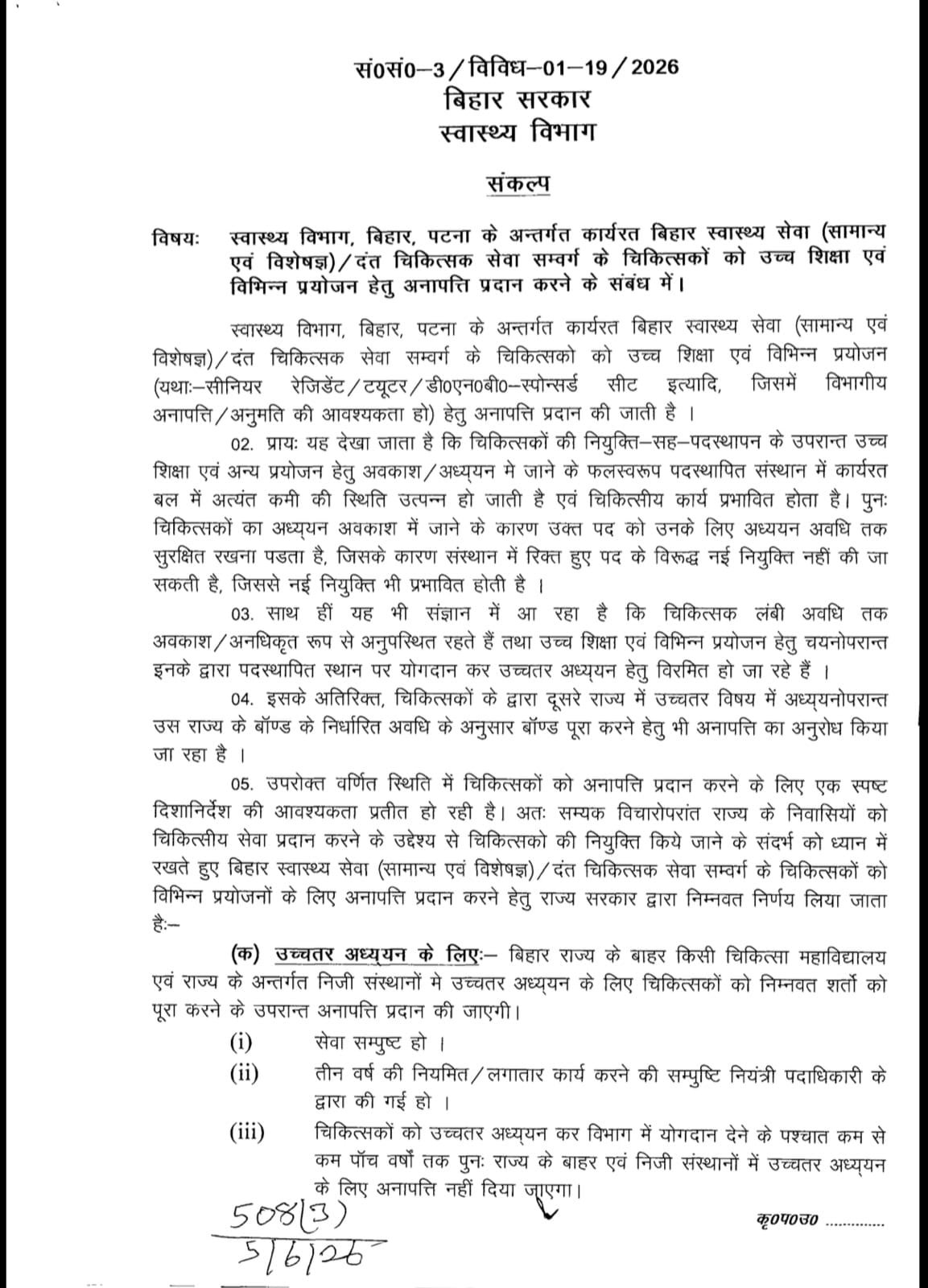
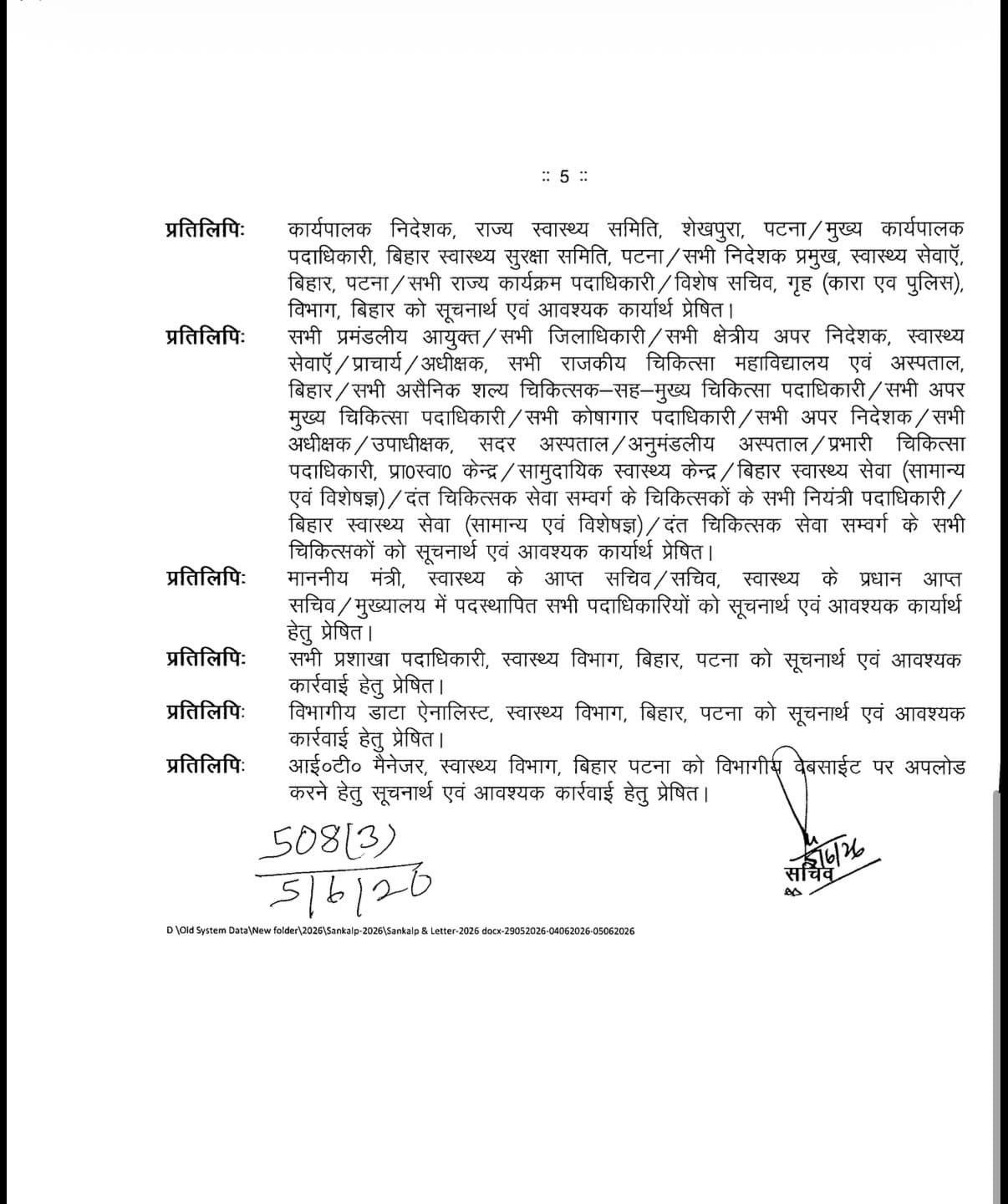
The Bihar Health Department, through Resolution No. 3/Vividh-01-19/2026 dated June 5, 2026, has issued revised guidelines governing the grant of NOCs to doctors belonging to Bihar Health Services and Bihar Dental Services.
The notification (NOC policy) lays down conditions under which doctors can obtain departmental permission for:
- Postgraduate studies (MD/MS/DNB)
- Super-specialty courses (DM/MCh)
- Senior Residency/Tutorship
- Sponsored DNB programs
- Higher positions and career advancement opportunities
The government has stated that the NOC policy was introduced after observing repeated manpower shortages caused by prolonged study leave, long absences, and vacancies that remained unfilled due to doctors pursuing higher education.
What Does the NOC policy Say?
Some of the major provisions include:
For Higher Education
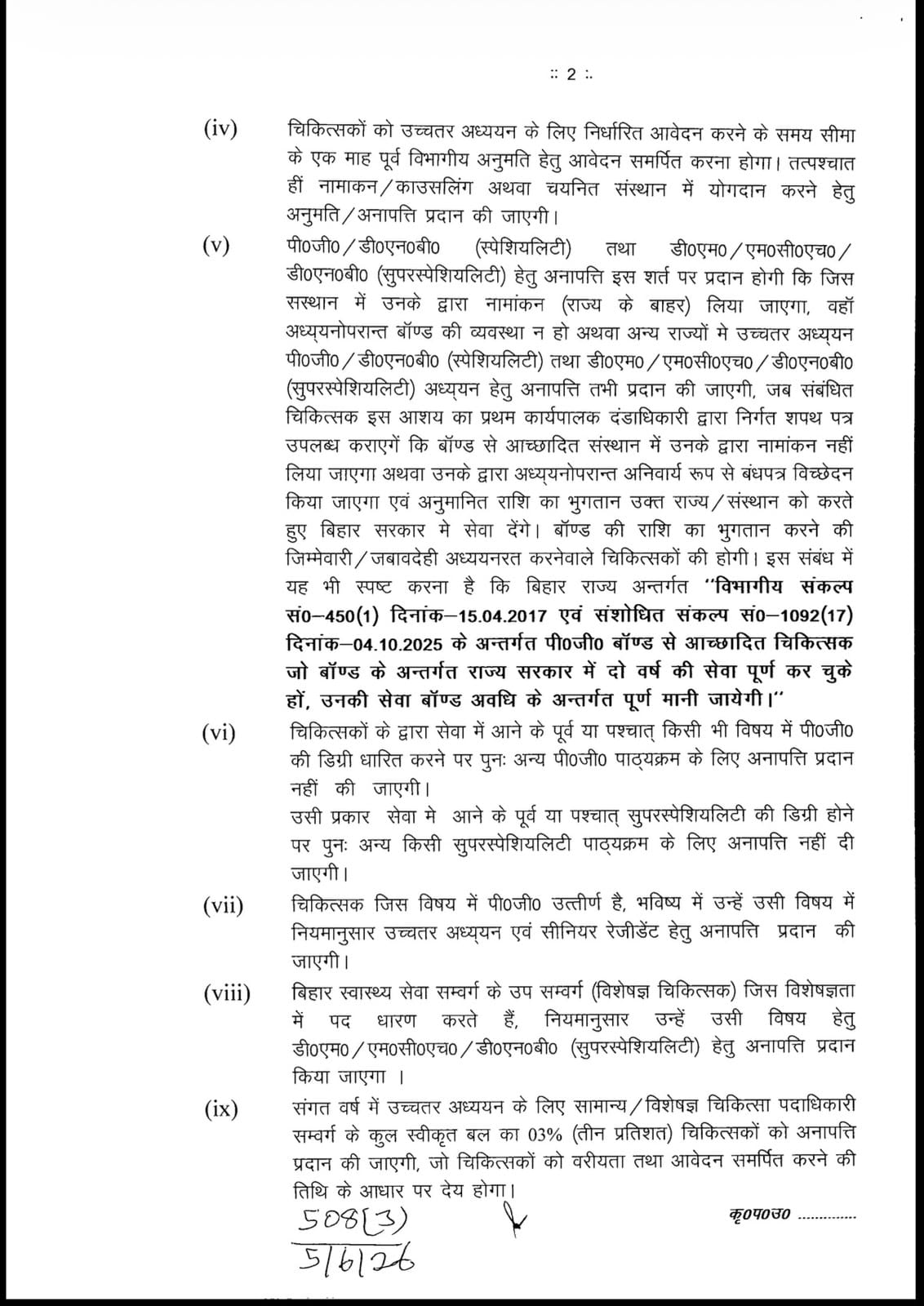
- Minimum 3 years of continuous government service is mandatory.
- Service must be confirmed and satisfactory.
- Only 3% of the sanctioned cadre strength can receive NOC for higher studies in a given year.
- Doctors who complete higher education and return to service cannot again receive NOC for higher studies outside Bihar or in private institutions for at least 5 years.
- Doctors already possessing a PG degree cannot obtain NOC for another PG course.
- Doctors already possessing a super-specialty degree cannot obtain NOC for another super-specialty course.
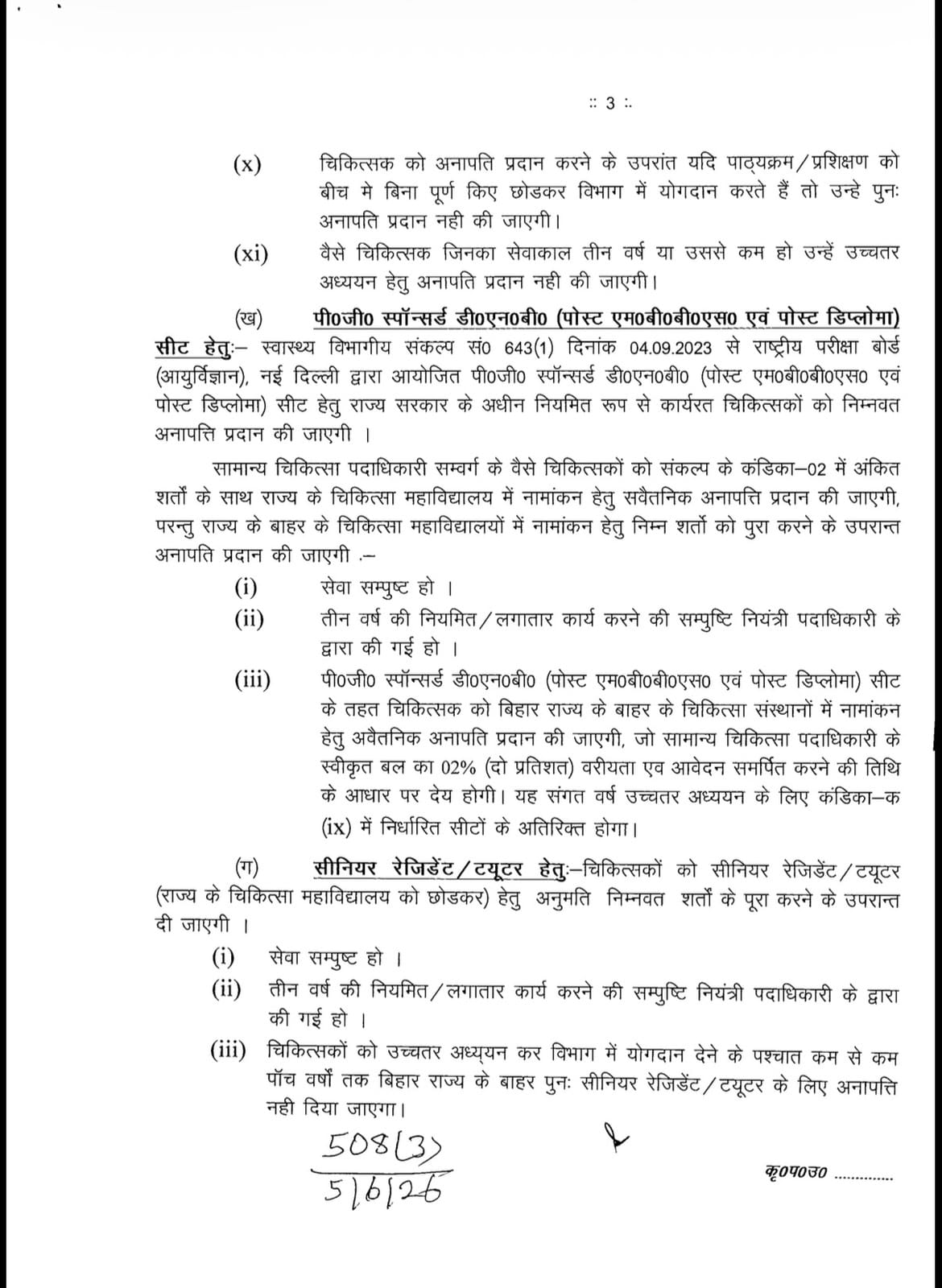
For Senior Residency/Tutorship
- Minimum 3 years of service required.
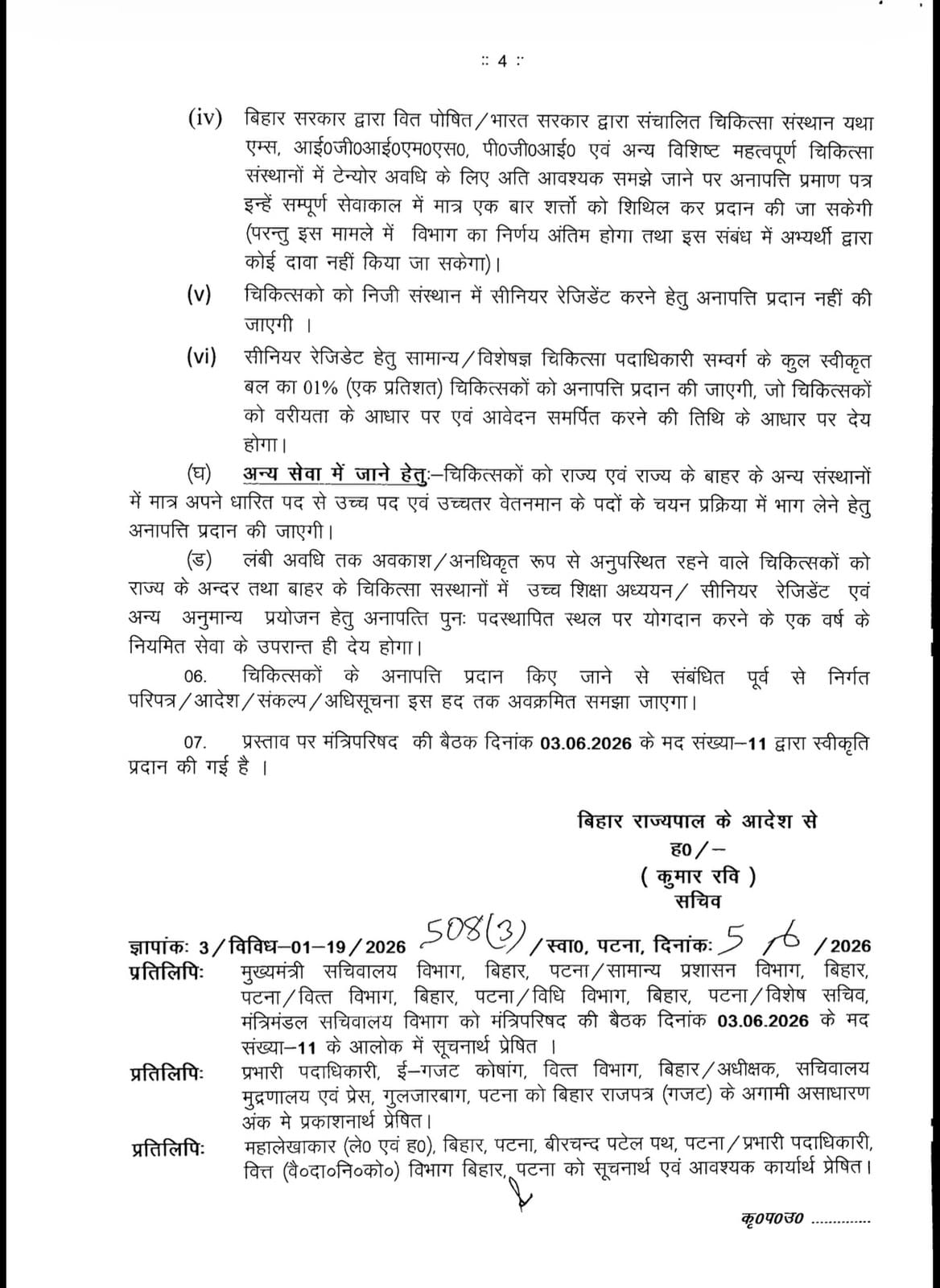
- Only 1% of sanctioned strength can avail NOC annually.
- Senior Residency in private institutions is generally not permitted.
Sponsored DNB Programs
- Limited to 2% of sanctioned strength.
- Subject to departmental approval and other conditions.
Other Restrictions of NOC policy
- Doctors leaving courses midway may not be eligible for future NOCs.
- Doctors absent for long periods must complete one year of regular service after rejoining before becoming eligible again.
Pros and Cons of NOC policy
Potential Advantages
- May help reduce manpower shortages in government hospitals.
- Ensures continuity of healthcare services in rural and underserved areas.
- Prevents excessive outflow of doctors from government institutions.
- Encourages doctors receiving government benefits to serve the state for longer durations.
- May improve workforce planning and administrative control.
Potential Disadvantages
- Restricts academic mobility and career progression.
- Limits opportunities for specialization and super-specialization.
- Creates uncertainty regarding future educational prospects.
- May discourage talented graduates from joining government service.
- Could increase migration toward private healthcare and other states.
Key Concerns and Why Doctors Are Opposing the New NOC Policy
1. Three-Year Mandatory Service Requirement
The requirement of three years of regular service before becoming eligible for higher studies is among the most debated provisions.
For MBBS graduates, postgraduate education is often considered a continuation of professional training rather than an optional academic pursuit. Delaying entry into postgraduate education may:
- Increase age at specialization.
- Delay acquisition of specialist skills.
- Affect competitiveness in national examinations.
- Disrupt long-term academic planning.
Many doctors argue that the most productive academic years are immediately after MBBS, and a prolonged mandatory service period may create educational stagnation.
2. Restrictive 3% Quota for Higher Education
Under the new policy, only 3% of the sanctioned cadre strength can receive NOC for higher studies annually.
Critics argue that:
- Hundreds of eligible doctors may compete for a very limited number of seats.
- Merit may become secondary to availability of quota.
- Doctors qualifying national examinations may still be unable to pursue admission.
- Opportunities could be lost despite securing high ranks.
This provision may create a bottleneck in specialist production.
3. Five-Year Lock-In Period After Higher Studies
The new NOC policy bars doctors from obtaining another NOC for higher studies outside Bihar or private institutions for at least five years after completing one higher course.
Many doctors believe that modern medicine increasingly requires layered specialization.
For example:
- MBBS → MD/MS → DM/MCh
- MBBS → DNB → Fellowship programs
- Clinical specialization followed by academic or research training
A five-year restriction may significantly delay academic advancement and reduce opportunities for super-specialization.
4. Senior Residency Restrictions
Senior Residency serves as a crucial bridge between postgraduate education and independent specialist practice.
The policy’s:
- 1% annual quota,
- mandatory service requirements,
- and restrictions on private institutions
may limit exposure to advanced clinical training and tertiary-care environments.
Experts warn that this could affect the quality of future faculty members and specialists.
5. Impact on Medical Academics and Research
Medical education is highly dynamic.
Restrictive NOC policies may lead to:
- Reduced participation in advanced training programs.
- Lower research output.
- Fewer super-specialists.
- Reduced representation of Bihar doctors in national academic institutions.
- Reduced faculty development in government medical colleges.
Over time, this may affect the state’s academic standing in medical education.
Impact of NOC policy on Medical Students and Young Doctors
The NOC policy is likely to affect medical students even before they join service.
Possible Consequences
- Reduced interest in joining Bihar government service.
- Preference for private sector employment.
- Migration to other states offering more flexible policies.
- Greater uncertainty regarding career planning.
- Increased stress among NEET-PG and INI-CET aspirants.
Many students view postgraduate education as an essential part of becoming a specialist. Restrictions on pursuing that path may influence employment decisions from the outset.
Legal and Constitutional Questions Being Raised on NOC policy
Several doctors’ organizations and legal observers have begun discussing whether certain provisions may be open to constitutional scrutiny.
Article 14 – Equality Before Law
Concerns may arise if similarly situated doctors are treated differently without a reasonable basis or if quota implementation lacks transparency.
Article 19(1)(g) – Freedom to Practice a Profession
Doctors may argue that excessive restrictions affecting educational advancement indirectly impact their ability to pursue their chosen profession and specialization.
Article 21 – Right to Life and Personal Liberty
The Supreme Court has, through various judgments, interpreted Article 21 broadly to include dignity, personal development, and access to opportunities essential for professional growth.
Right to Education Concerns
While the Constitution explicitly guarantees free and compulsory education up to a certain age under Article 21A, some stakeholders argue that unreasonable barriers to higher professional education may conflict with the broader constitutional vision of educational advancement and professional development.
Need for Judicial Review
Whether these provisions ultimately violate constitutional rights can only be determined by courts. At present, these remain legal concerns and arguments that may be raised in future challenges.
Suggested Amendments and Solutions
Experts and doctors have proposed several reforms that could balance service needs with academic growth.
1. Reduce Mandatory Service Requirement
- Reduce from 3 years to 1 year.
- Provide additional relaxation for difficult and remote postings.
2. Increase Higher Education Quota
- Raise NOC quota from 3% to at least 10–15%.
- Adjust annually based on workforce availability.
3. Reduce Lock-In Period
- Reduce from 5 years to 2 years.
- Allow exceptions for super-specialty courses and nationally competitive programs.
4. Merit-Based Priority System
- Give preference to candidates qualifying NEET-PG, INI-CET, and NBE examinations with high ranks.
- Ensure transparent online allocation.
5. Expand Senior Residency Opportunities
- Increase quota beyond 1%.
- Allow accredited private institutions where government seats are unavailable.
6. Create Return-Service Bonds
Instead of restricting education, the government may:
- Permit higher studies freely.
- Require doctors to return and serve Bihar for a specified duration.
This model is already used successfully in many states.
7. Stakeholder Consultation
- Include representatives of resident doctors.
- Consult medical associations.
- Seek input from medical colleges and public health experts.
Conclusion
The Bihar government’s new NOC policy has been introduced with the stated objective of ensuring adequate healthcare manpower and preventing disruptions in public health services. However, many provisions of the notification have raised serious concerns among doctors, residents, and medical students regarding academic freedom, specialization opportunities, and long-term career growth.
The challenge before policymakers is to strike a balance between public healthcare needs and the legitimate aspirations of medical professionals. A policy that protects healthcare services while simultaneously encouraging higher education, specialization, and research will ultimately serve both doctors and patients.
As discussions continue, stakeholders hope that the government will engage with the medical community and consider practical amendments in the NOC policy that strengthen Bihar’s healthcare system without restricting the academic future of its doctors.
For more details on New NOC policy, follow us on X (Twitter), Instagram & Facebook. And our website MED COLLEGE DARSHAN.
No responses yet