
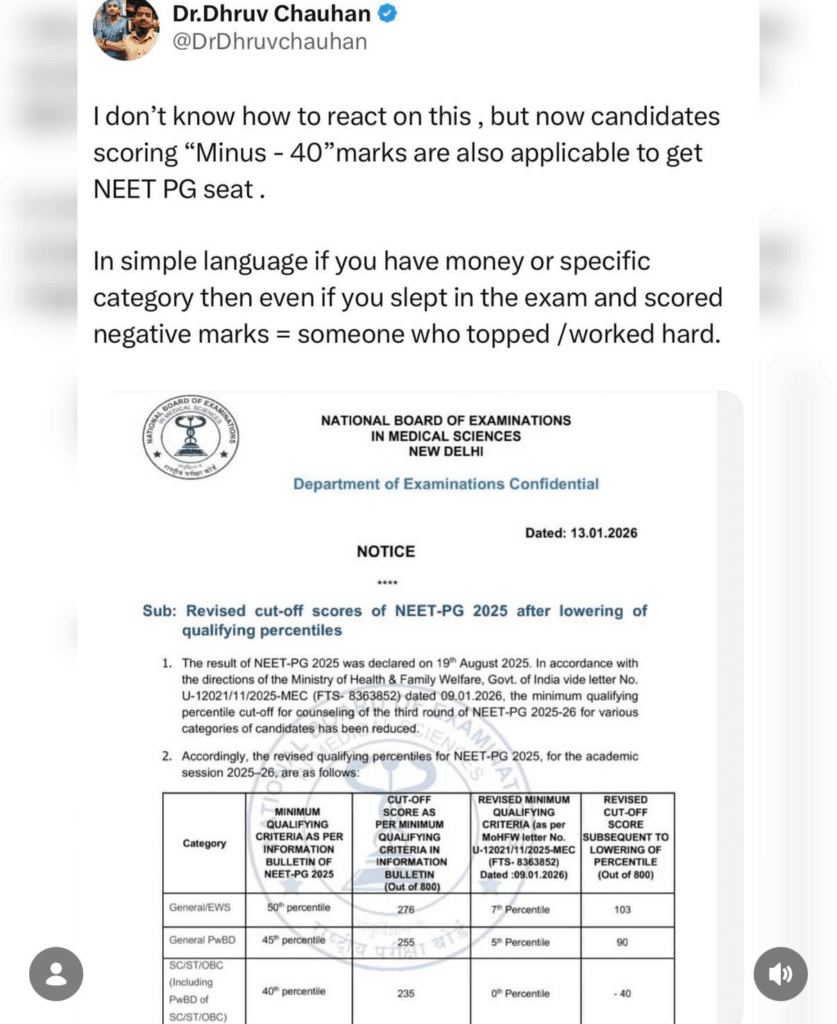
NEET PG 2025 Cut Off : The National Board of Examinations in Medical Sciences (NBEMS) has lowered the qualifying percentile to zero for candidates in NEET PG 2025 Cut off, allowing even those with negative scores (as low as -40 out of 800) to become eligible for the third round of counselling. The move, aimed at filling thousands of vacant postgraduate medical seats, has triggered intense debate within the medical community, with many doctors warning that such decisions may seriously compromise patient care and weaken healthcare standards in the long run.
Table of Contents
Over 18,000 Seats Vacant After Round 2
Health Ministry sources stated that the decision of NEET PG 2025 Cut Off was taken after the completion of Round-2 counselling, during which more than 18,000 PG medical seats reportedly remained unfilled across government and private medical colleges. Officials argue that leaving such a large number of seats vacant is a waste of national resources and affects healthcare delivery due to shortages of resident doctors.
“Leaving seats vacant undermines national efforts to improve healthcare delivery and results in the loss of valuable educational resources,” sources said.
Government Says NEET-PG is Only a Ranking Tool
Defending the decision, Health Ministry sources insisted that the move does not dilute academic standards, claiming that all candidates appearing for NEET-PG are already MBBS-qualified doctors who have completed internship.
Officials described NEET-PG as a ranking mechanism, used only for transparent and merit-based seat allocation through centralized counselling. They maintained that admissions would still follow inter-se merit, rank, and preference-based allocation, leaving “no scope for discretionary or direct admissions.”
Medical Community Divided: Seat Utilisation vs Safety Concerns
While the ministry sees the decision as an effort to utilise infrastructure and fill vacant seats, doctors’ bodies remain sharply divided.
The Indian Medical Association (IMA) had written to Health Minister J.P. Nadda on January 12, urging the government to lower the NEET PG 2025 Cut Off. In its letter, the IMA argued that high eligibility thresholds were excluding “otherwise competent and willing candidates,” leading to:
- Shortage of resident doctors
- Increased workload on existing trainees
- Adverse effects on patient care, especially in government hospitals
The NEET PG 2025 Cut Off revision was issued the very next day, on January 13, according to the report.
FAIMA Warns: “Negative Marks Now Eligible”
However, the decision has drawn strong opposition from doctors’ groups like the Federation of All India Medical Associations (FAIMA), which termed the move dangerous and unprecedented.
FAIMA strongly criticized the reduction of NEET PG 2025 Cut Off percentile to zero, stating that it effectively means even candidates with negative marks can now enter postgraduate training. Adding that such candidates could eventually be involved in clinical responsibilities, including procedures and surgeries.
Concern: Merit Dilution May Lead to Poorer Patient Outcomes
Many doctors argue that postgraduate medical training is not just about filling seats but about producing specialists capable of handling critical, life-saving responsibilities. They fear that lowering eligibility to the extent of allowing negative scorers may lead to:
- Lower competency levels among trainees
- Compromised clinical decision-making
- Higher risk of medical errors
- Long-term decline in public trust in healthcare
Critics believe that in high-pressure departments like medicine, paediatrics, emergency care and surgery, merit and competency are directly linked to patient survival and outcomes, and any compromise could be catastrophic.
Allegations of Private College Seat-Filling Pressure
Doctors also raised concerns that the decision on NEET PG 2025 Cut Off may be indirectly linked to the need to fill vacant seats in private medical colleges, many of which remain unattractive due to poor training environment and alleged that several institutions lack:
- Adequate faculty
- Sufficient patient exposure
- Proper infrastructure and academic ecosystem
A Bigger Question: Why Are So Many Seats Vacant?
The controversy has also reignited a larger debate in medical education—if tens of thousands of PG seats remain vacant year after year, the problem may not lie with student eligibility alone, but with:
- Uneven distribution of seats across specialties
- High fees in private colleges
- Lack of stipend and working conditions in some institutions
- Poor quality training in certain colleges
- Increasing burnout and dissatisfaction among doctors
Doctors argue that instead of repeatedly lowering NEET PG 2025 Cut Off, the system must address why candidates are not opting for these seats in the first place.
Conclusion: Balancing Workforce Needs with Quality
While the government insists that expanding eligibility will help fill seats and reduce manpower shortages, critics say the decision risks turning a serious competitive exam into a mere formality, potentially affecting the quality of specialists entering India’s healthcare system.
As the debate continues, many in the medical community are demanding that reforms focus on improving training quality, regulating private institutions, strengthening infrastructure, and ensuring patient safety, rather than lowering standards to fill vacant seats.
Because in medicine, the cost of compromised merit is not academic—it is paid by patients.
For more updates on NEET PG 2025 Cut Off, follow us on X (Twitter), Instagram & Facebook. And our website MED COLLEGE DARSHAN.

No responses yet