Table of Contents
MGM Medical College, Indore :
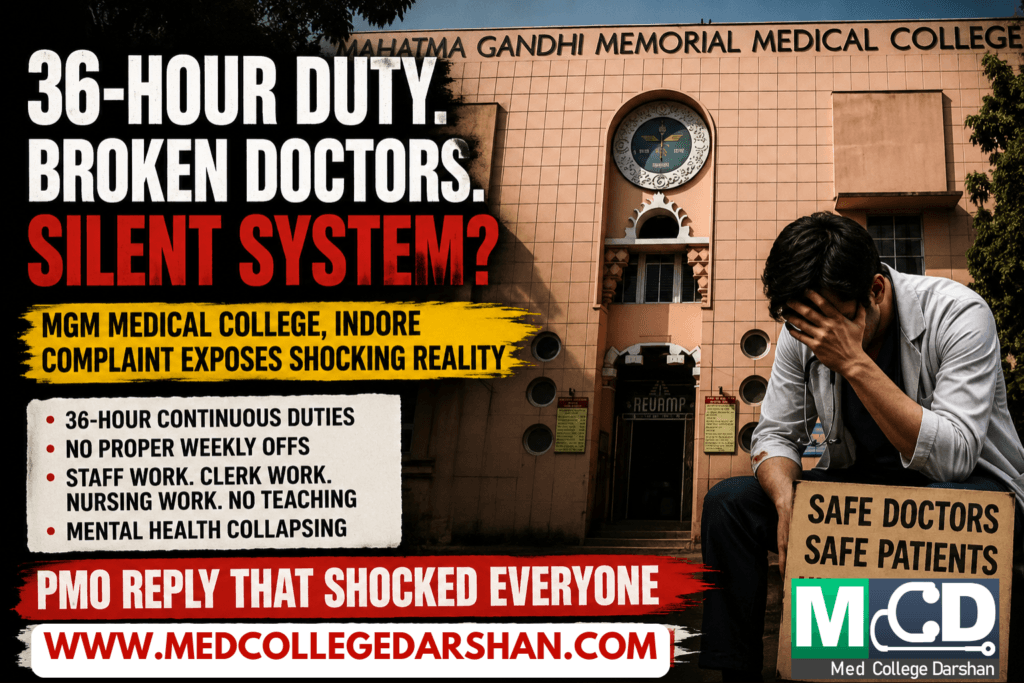
A deeply disturbing complaint from MGM Medical College, Indore, has exposed what appears to be a dangerous pattern of systemic exploitation, administrative denial, and bureaucratic insensitivity toward postgraduate resident doctors — particularly in the Department of Obstetrics & Gynaecology.
The complaint, initially filed through the CM Helpline and later escalated to the Prime Minister’s Office (PMO), alleges that resident doctors are being forced into repeated continuous duties of up to 36 hours, often without adequate weekly offs, under conditions that threaten not only their physical and mental health but also patient safety.
The complaint was formally raised by RTI activist and member of United Doctor’s Front (UDF) Rishabh Jaiswal, by filing detailed grievances through both the CM Helpline Complaint No. 29295988 and the Prime Minister’s Office Public Grievance Portal Complaint No. PMOPG/E/2026/0076540. Rishabh highlighted the inhumane working conditions faced by postgraduate resident doctors. His intervention brought national attention to a deeply rooted systemic issue, questioning how medical trainees can be expected to deliver safe patient care while functioning under extreme exhaustion.
The Ground Reality: Resident Doctors Pushed Beyond Human Limits
According to the grievance, postgraduate doctors at MGM Medical College are routinely subjected to:
- Continuous 36-hour shifts
- Severe sleep deprivation
- Mental and physical exhaustion
- Additional clerical, nursing, and staff responsibilities
- Lack of proper academic teaching despite being trainees
- Fear of retaliation for speaking out
The complainant described these working conditions as “grossly unsafe and inhuman,” citing violations of NMC guidelines and the Residency Scheme of 1992 designed to ensure humane training standards for medical residents.
Such prolonged overwork in a high-risk specialty like Obstetrics and Gynaecology raises urgent concerns:
- Can an exhausted doctor provide safe maternal care?
- Are patients unknowingly being treated by severely sleep-deprived professionals?
- Has institutional workload become more important than both doctor welfare and patient lives?
CM Helpline Response: Administrative Formality Without Real Accountability
After the complaintof MGM Medical College, the official response from the institution largely justified the prolonged duties by citing:
- High patient load
- Emergency care requirements
- Need for continuity in specialist training
Rather than acknowledging systemic abuse, the response promised “review” and “monitoring,” while avoiding concrete corrective action.
This raises troubling concerns about whether complaint systems are functioning as mechanisms for justice — or working just for institutional defense.
PMO Complaint: A National Appeal Met With a Shocking Response
When the issue of MGM Medical College was escalated to the Prime Minister’s Office, the complainant expected intervention at the highest administrative level. Instead, the response was shocking.
The reply reportedly defended the culture of extreme medical training, stating that rigorous duty is essential for specialist development and that many doctors undergo such hardship without regret. It further implied that those unable to cope may simply be “physically, developmentally, or emotionally weak.”
Why This Response Is Alarming
This response has triggered serious ethical and policy concerns because it appears to:
1. Normalize Exploitation
Rather than addressing unsafe practices, the system seemingly frames abusive duty conditions as tradition.
2. Shift Blame to Victims
Doctors facing burnout, psychological distress, or suicidal thoughts are indirectly characterized as weaker individuals rather than victims of institutional overburdening.
3. Ignore Modern Medical Safety Standards
Globally, excessive resident work hours are recognized as a patient safety issue, not merely a training concern.
4. Undermine Mental Health Concerns
The complainant explicitly mentioned deteriorating mental health and suicidal ideation, yet the response appears administrative rather than urgent.
A Larger Question: Is the System Protecting Institutions More Than Doctors?
This case of MGM Medical College reflects a broader national issue:
- Are grievance portals truly independent?
- Can resident doctors safely report abuse without retaliation?
- Are duty hour regulations being enforced only on paper?
- Why are repeated complaints met with bureaucratic rationalization instead of transparent audits?
Medical Education or Institutionalized Burnout?
India’s healthcare system heavily depends on resident doctors, but this dependence cannot justify conditions that border on exploitation.
When young doctors are overworked to collapse, denied humane schedules, and dismissed when they speak up, the consequences extend beyond individual suffering:
- Increased medical errors
- Burnout-driven workforce attrition
- Mental health crises
- Decline in training quality
- Public health risk
The Need for Immediate Reform
This issue demands:
- Independent audits of real duty hours
- Enforcement of NMC duty regulations
- Confidential anti-retaliation protections
- Resident welfare committees with real authority
- Transparent grievance review outside institutional influence
Conclusion
The MGM Medical College complaint is more than a local administrative issue — it is a mirror reflecting the troubling normalization of overwork within India’s medical training ecosystem.
When resident doctors plead for humane conditions and receive responses defending the very system causing harm, the question becomes unavoidable:
Is the system truly reforming medical education, or merely preserving a culture of silence and endurance at the cost of young doctors’ lives?
Until this question is answered with action rather than paperwork, such complaints will remain symbols of systemic failure rather than pathways to justice.

For more details on MGM medical college, follow us on X (Twitter), Instagram & Facebook. And our website MED COLLEGE DARSHAN.
No responses yet