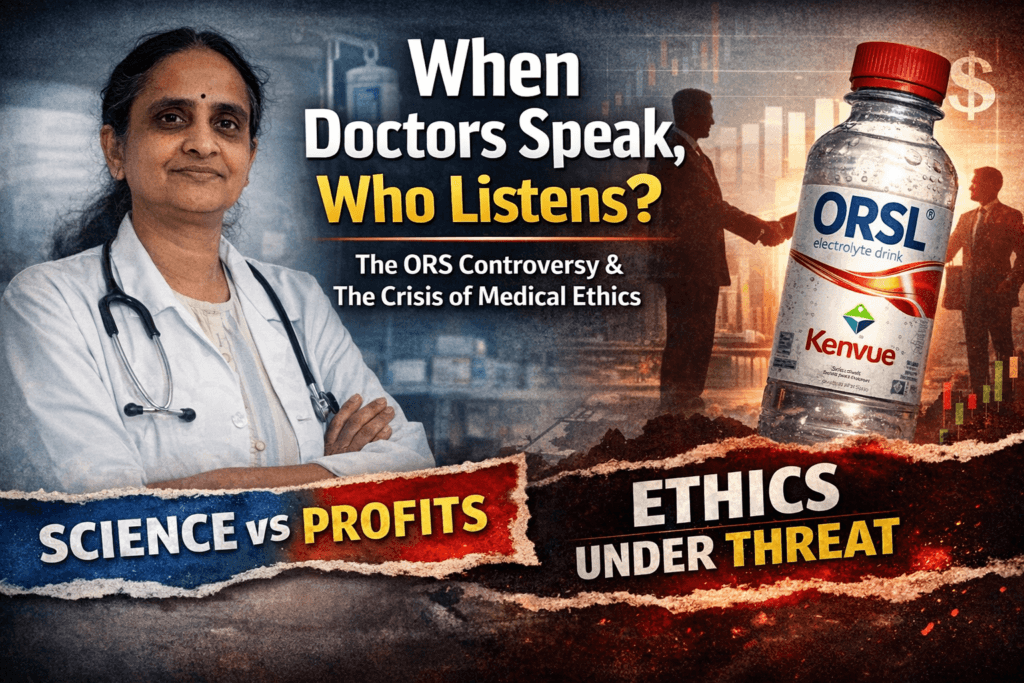
A subtle but deeply concerning shift is being felt across modern healthcare—a shift in power, perception, and perhaps priorities. For decades, medicine has operated on a simple hierarchy: scientific evidence guides doctors, and doctors guide treatment practices, while pharmaceutical and consumer health companies follow that lead. Today, that order appears less certain.
The recent controversy surrounding Oral Rehydration Solution (ORS) and commercially marketed electrolyte drinks has brought this issue into sharp focus, raising difficult questions about ethics, influence, and institutional responsibility.
A Doctor’s Stand for Science
At the center of this debate is Dr. Sivaranjani Santosh, who raised a critical and evidence-based concern: products marketed as ORS-like—such as ORSL—risk creating dangerous confusion among parents and caregivers.
This is not a trivial issue. ORS, as defined by the World Health Organization, is a precisely formulated, life-saving therapy used to treat dehydration, particularly in children suffering from diarrheal diseases. Its composition is scientifically calibrated to restore fluid and electrolyte balance effectively.
When commercial beverages position themselves as equivalent or similar, the risk is not merely semantic—it is clinical. A caregiver substituting a non-standard drink for WHO-recommended ORS may unknowingly compromise a child’s treatment.
Dr. Santosh’s intervention was not activism. It was the essence of evidence-based medicine: identifying a potential public health risk and speaking up.
The Corporate Context: Scale, Power, and Influence
The product at the heart of this controversy is linked to Kenvue, a company that emerged in 2023 from the consumer health division of Johnson & Johnson.
While Kenvue now operates independently, its lineage reflects the scale, reach, and influence of one of the world’s largest healthcare corporations.
It is important to view this context with nuance:
- Johnson & Johnson has faced multiple global litigations, particularly concerning talc-based products and broader consumer safety issues.
- Kenvue itself is currently navigating investor lawsuits, including concerns around product disclosures such as the effectiveness of phenylephrine.
These are ongoing legal matters and allegations—not established criminal convictions. However, they highlight a broader reality: large corporations operate within complex legal and ethical landscapes, where commercial interests and public health responsibilities may sometimes intersect uncomfortably.
The Silence of Institutions
Perhaps more concerning than corporate conduct is the perceived response—or lack thereof—from within the medical community itself.

The Indian Academy of Paediatrics (IAP), a body expected to uphold scientific rigor and ethical clarity, was perceived by many as:
- Slow in responding to the issue
- Ambiguous in its public stance
- Reluctant to openly support a colleague raising a legitimate public health concern
Simultaneously, concerns have been raised about industry presence at major conferences like PEDICON, where commercial products—including ORSL—were reportedly promoted.
While industry participation in medical conferences is not new, it underscores the importance of maintaining clear ethical boundaries. When commercial entities share platforms with scientific discourse, the line between education and promotion must remain sharply defined.
ORSL stall in PEDICON :

A Larger Ethical Question
This controversy ultimately raises a deeper and more uncomfortable question:
Are medical organisations maintaining their independence, or are they gradually aligning with corporate interests?
Financial relationships—whether through sponsorships, exhibitions, or partnerships—are not inherently unethical. In many cases, they support academic exchange and innovation.
However, the challenge lies in perception and transparency.
Even the appearance of influence can erode trust.
And in medicine, trust is not optional—it is foundational.
The Dangerous Shift in Perception
Among many doctors, a sentiment is quietly gaining ground:
Earlier, pharmaceutical companies followed doctors.
Now, there is a fear that doctors and institutions may be influenced—directly or indirectly—by corporate forces.
Whether this perception is entirely accurate is almost secondary.
Because perception shapes trust.
And once trust begins to erode, the consequences extend far beyond individual controversies.
Why This Matters
Healthcare is fundamentally different from any other industry.
- Patients are vulnerable
- Clinical decisions carry life-altering consequences
- Public trust determines the effectiveness of entire health systems
Commercial success and ethical responsibility must coexist—but never at the cost of patient safety.
There are countless ways to generate revenue in the world. Medicine cannot become one where commercial messaging overshadows scientific truth.
Accountability Within the Profession
Medical organisations were established with clear mandates:
- To uphold standards of care
- To support healthcare professionals
- To protect patient welfare
When any of the following begin to occur:
- Ethical clarity becomes blurred
- Doctors raising valid concerns feel isolated
- Public health messaging becomes diluted
It signals the need for serious introspection—not at the margins, but at the highest levels of leadership.
The Way Forward
This moment should not be viewed as a controversy to be contained—but as an opportunity to recalibrate.
Key steps forward include:
- Strengthening transparency in all industry relationships
- Clear differentiation between therapeutic formulations and commercial beverages
- Active institutional support for doctors who raise evidence-based concerns
- Reinforcing ethical firewalls in conferences, guidelines, and endorsements
Progress in medicine has never come from silence. It has always depended on those willing to question, challenge, and refine existing systems.
Final Words
This is not an attack on institutions.
It is a call to preserve their credibility.
A strong medical body is not one that avoids discomfort—but one that stands firm on science, ethics, and patient welfare, especially when doing so is difficult.
Because in the end, one principle must remain non-negotiable:
No financial consideration should ever outweigh the responsibility we carry toward patient health. And when doctors speak—not for themselves, but for science—the system must not only listen. It must stand with them.
For more details, follow us on X (Twitter), Instagram & Facebook. And our website MED COLLEGE DARSHAN.
No responses yet