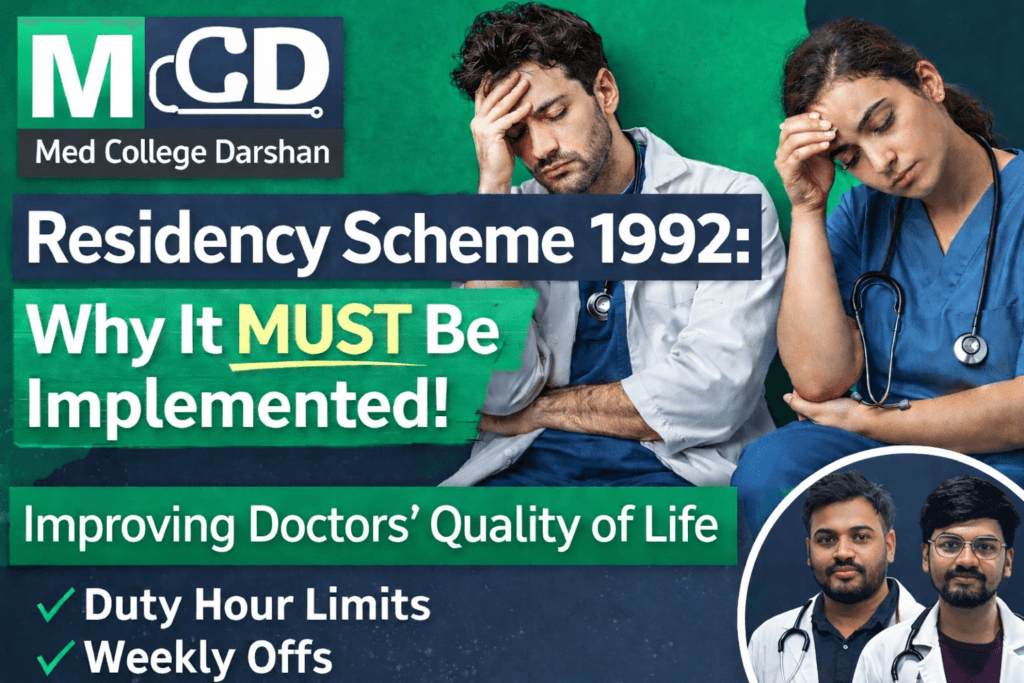
Residency Scheme 1992 is not just a phase in a doctor’s journey—it is the foundation upon which an entire medical career is built. It is during this period that a young medical graduate transforms into a responsible clinician, learns to make life-saving decisions, and develops the ethics and resilience that define the profession. The experiences of residency stay with a doctor for life and ultimately shape the quality of healthcare delivered to society.
However, the reality of residency in India today stands in stark contrast to what it should be. Instead of being a structured learning experience, it has increasingly become a period of survival. Overworked, underpaid, and mentally exhausted, resident doctors are pushed into inhumane working conditions that compromise not only their well-being but also patient care.
Recognizing this systemic exploitation, the Supreme Court of India directed the formation of a Uniform Central Residency Scheme 1992, which led to the formulation of the Central Residency Scheme 1992—a landmark framework aimed at standardizing and humanizing residency across government institutions.
Yet, more than three decades later, its implementation remains inconsistent and largely ignored.
Click Here To Download Central Residency Scheme
What the Residency Scheme 1992 Actually Promises
The official Central Residency Scheme 1992 document clearly lays out a structured and humane system for residency. According to the scheme:
1. Defined Duty Hours
The scheme explicitly states that:
- Continuous duty should not exceed 12 hours
- Junior residents should work around 48 hours per week
- On-call duty should not exceed 12 hours at a stretch
But in reality, residents routinely work 70–120 hours per week, leading to burnout, poor decision-making, and increased risk of medical errors.

2. Weekly Off is a Right, Not a Privilege
The Residency Scheme 1992 scheme guarantees:
- One weekly holiday by rotation
Yet, for most residents, this exists only on paper. The constant “exigency of work” has turned weekly offs into a rare luxury.
3. Accommodation for Round-the-Clock Care
The scheme emphasizes:
- Free furnished accommodation
- Free electricity and water within limits
This aligns with the very concept of a “resident” doctor—someone available 24/7. However, due to poor infrastructure, many doctors either live in overcrowded hostels or far from hospitals, defeating the purpose of residency.
4. Structured Training & Defined Tenure
The scheme introduced:
- A 6-year structured residency system (Junior + Senior Residency)
- Junior Residency:
- 3 years (degree) / 2 years (diploma)
- Senior Residency:
- 3-year tenure
This ensures a clear academic and professional progression—something that is often distorted due to administrative inconsistencies.
5. Financial Support & Allowances
The scheme provides for:
- Monthly stipends linked to government pay scales
- Book allowance (₹1000–₹1500/year)
- Thesis financial assistance
- DA, HRA, and other benefits
However, lack of awareness and uneven implementation means many residents never fully receive these benefits.
6. Leave & Welfare Provisions
The scheme includes:
- 30–36 days annual leave
- LTC for senior residents (home town once in 2 years)
Despite this, residents often struggle to even get basic leave approved.
Why Implementation is Crucial Today
The failure to implement the Residency Scheme has far-reaching consequences:
1. Burnout is Becoming the Norm
Sleep-deprived, mentally drained doctors cannot function optimally. This is not just a workforce issue—it is a public health crisis.
2. Patient Care is Directly Affected
Exhaustion leads to:
- Increased medical errors
- Reduced empathy
- Poor clinical judgment
A well-rested doctor is not a luxury—it is a necessity for safe healthcare.
3. Loss of Passion in Young Doctors
When residency becomes a struggle for survival, doctors begin to lose the very reason they chose medicine. This leads to:
- Decreased morale
- Rising mental health issues
- Increased dropouts and migration
4. Lack of Uniformity Across India
Different institutions follow different rules, leading to:
- Unequal workload
- Unequal pay
- Unequal opportunities
The Central Residency Scheme 1992 was designed to ensure:
“Same work, same pay, same structure.”
The Role of Unity: Med Influencers & Associations
The biggest barrier today is not policy—it is implementation.
And implementation requires collective pressure.
Why Unity Matters
- Individual voices are ignored
- Collective movements create policy change
- Awareness leads to accountability
Med Influencers: The New Voice of Doctors
In today’s digital age:
- Medical influencers can amplify issues
- Social media can bring national attention
- Real stories can create emotional impact
They have the power to:
👉 Turn silent suffering into a national conversation
Medical Associations: The Backbone of Reform
Organizations like resident doctor associations, national bodies, and student groups must:
- Demand strict implementation
- Push for policy enforcement
- Engage with government authorities
Only a united front can ensure change.
The Way Forward
The Residency Scheme 1992 is not outdated—it is underutilized.
Its proper implementation would:
- Humanize residency
- Improve patient care
- Restore dignity in the profession
- Create a sustainable healthcare system
But this will not happen automatically.
It requires:
- Awareness among doctors
- Advocacy by associations
- Amplification by influencers
- Accountability from institutions
Conclusion
The Residency Scheme 1992 was a visionary step taken decades ago to protect the backbone of India’s healthcare system—its resident doctors.
Today, the need is not to create new policies, but to implement what already exists.
Because when doctors are overworked, the entire healthcare system suffers.
And when doctors are supported, patients heal better, systems function stronger, and the future of medicine becomes brighter.
For more details, follow us on X (Twitter), Instagram & Facebook. And our website MED COLLEGE DARSHAN.
No responses yet